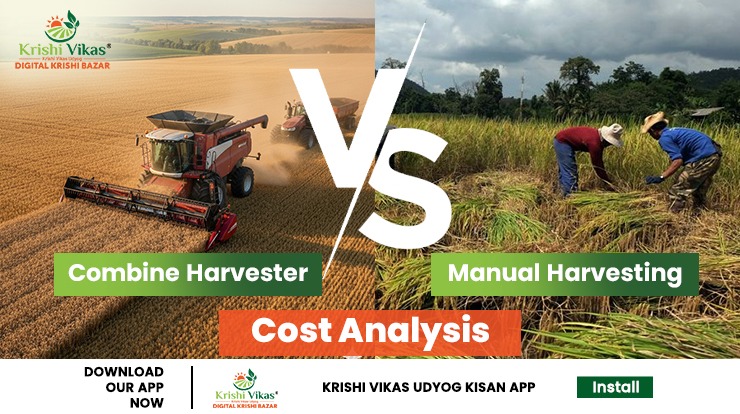
Opting for a manual harvesting or a combine harvester can be confusing for every farmer. Let’s help them with a detailed cost analysis to make an informed harvesting decision.
Detailed cost analysis of the combine harvester and manual harvesting
Manual harvesting is labour-intensive work that takes a lot of time. Whereas, a combine harvester prioritizes modern farming mechanisms for high profit in less time. Let’s discuss the overall cost analysis of combine and manual harvesting.
Capital Investment and Equipment Expenditure
In terms of costing, manual harvesting is cheaper than a combine harvester. The starting price of a combine harvester in India is approximately ₹12,70,000*, whereas the cost of manual harvesting tools starts under ₹10,000*. Hoes, spades, and sickles are some of the affordable options used in manual harvesting, whereas grain tanks, augers, and headers are parts used in combine harvesters, which are very costly.
Labour Involvement and Associated Costs
In terms of the workforce consumption and labour expenses, let’s compare the labour costs and the workforce requirement for combine harvesting and manual harvesting.
Manual harvesting isn’t easy. It takes a whole team — 15 to 20 labourers for just one hectare of rice or wheat. Long days under the sun. Slow progress. Rising costs. During the peak season, labour charges shoot up anywhere between ₹8,000 to ₹15,000 per hectare. Add food, travel, and the extra days it takes — the numbers pile up fast.
Now, look at the other side. The combine harvester. One machine. One operator. Hours instead of days. More than 80% of the work is done automatically. The machine cuts, threshes, and cleans, all in one go. For farmers, it’s not just about convenience anymore; it’s about cost, time, and efficiency. And in that race, the combine harvester is clearly miles ahead.
Operational Output and Time Utilization
When the crop is ready, every hour counts. A single day’s delay can turn a farmer’s hard work into a loss. That’s where the real difference shows. With a combine harvester, one hectare can be harvested in just 2 to 4 hours. Manually? It takes around 20 to 40 man-hours per hectare.
The machine’s speed speaks for itself, about 2.5 to 3 acres per hour, while manual harvesting drags on for days. In short, when time is money, the combine harvester saves both.
Financial Returns and Long-Term Profit Margins
Let’s take a look at the long-term profitability and ROI for both harvesting methods
- The farming cost can be reduced by 35% to 70% through the combine harvesting method
- For every rupee spent, combine harvesters give back more than 1.58 times compared to 1.50 through manual methods.
- The chance of harvest loss can be reduced by around 4.5% compared to manual harvesting
Summing up
In conclusion, combine harvesters offer superior efficiency and convenience for large-scale operations, whereas mini harvesters present a cost-effective and productive alternative for small-scale farmers. Ultimately, the right choice depends on farm size, budget, and the farmer’s goal of saving time, money, or both.