RBI Flags El Niño, Uneven Monsoon as Key Risks to Indian Agriculture and Rural Demand
The Reserve Bank of India (RBI) has flagged El Niño conditions and an uneven southwest monsoon as key risks to India’s agriculture sector, rural demand and the broader economic outlook. RBI Flags El Niño Risk: Krishi Vikas Viewpoint. Also read August Tractor Buying Guide blog at Krishi Vikas.com.
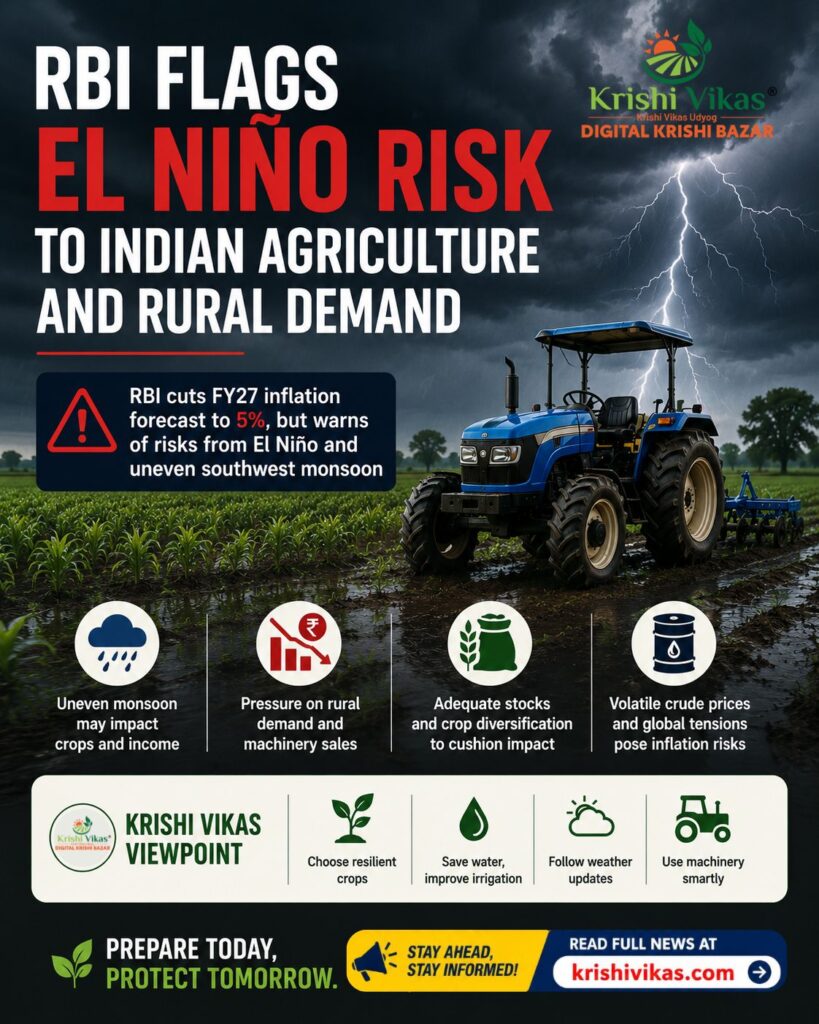
The warning comes even as the RBI’s Monetary Policy Committee (MPC) revised its FY27 inflation forecast to 5%. RBI Governor Sanjay Malhotra said that while inflationary pressures remain relatively contained, weather-related disruptions could affect agricultural production and rural consumption.
“Deficient and uneven southwest monsoon amidst El Niño conditions poses some risks to the agriculture sector’s outlook and rural demand,” Malhotra said in his monetary policy address.
El Niño: Impact on Farmers
El Niño can influence the timing and geographical distribution of rainfall across India. Even when overall seasonal rainfall is not significantly below normal, uneven rainfall can create serious problems for farmers. The impact is likely to be greater in rain-fed agricultural regions, where farmers have fewer irrigation options.
Long dry spells followed by heavy rainfall can affect:
- Kharif sowing
- Seed germination
- Crop growth
- Fertiliser application
- Irrigation requirements
- Crop yields
- Farm income
Impact on Rural Demand and Farm Machinery
The effects of an uneven monsoon can extend beyond crop production. A weaker harvest can reduce farm income, potentially leading farmers to postpone large investments such as new tractors, harvesters and other agricultural machinery. Farmers may instead prioritise essential inputs and repairs over new machinery purchases.
However, the impact will not necessarily be negative across the entire tractor market. Farmers in irrigated regions or areas benefiting from strong crop prices may continue to invest in mechanisation. There could also be greater demand for machinery that improves water efficiency, timely sowing and harvesting, as farmers look for ways to reduce weather-related risks.
Krishi Vikas Viewpoint: From Weather Risk to Farm Resilience
At Krishi Vikas, we believe the bigger issue is not simply whether El Niño will weaken the monsoon.
The bigger question is: How prepared are Indian farmers for an uneven monsoon?
India’s agricultural sector cannot control rainfall patterns, but farmers can reduce their exposure to rainfall uncertainty through better planning, water management, crop choices and access to timely information. For farmers, climate resilience should increasingly become part of everyday farm planning rather than a response after a weather shock occurs.
1. Move Towards Climate-Resilient Crops
Farmers should consider short-duration, drought-tolerant and climate-resilient varieties suited to their local soil and weather conditions. This can help reduce the risk of crop failure when rainfall is delayed or interrupted.
2. Diversify Crops
Depending entirely on one crop increases financial risk. Farmers can consider a combination of crops based on local conditions, irrigation availability and market demand. Crop diversification can provide a safety net when one crop is affected by adverse weather.
3. Focus on Water Conservation
Water availability could become one of the most important factors during an uneven monsoon. The objective should be simple: capture more rainwater and waste less irrigation water.
Farmers should explore: Farm ponds
- Rainwater harvesting
- Drip irrigation
- Sprinkler systems
- Mulching
- Water-efficient irrigation practices
- Soil-moisture conservation
4. Use Weather Information Before Sowing
Farmers should avoid making sowing decisions based solely on the first rainfall. Monitoring local weather forecasts, rainfall trends and agricultural advisories can help farmers decide when to sow and which crop or variety to select. Access to timely information can be as valuable as access to farm inputs.
5. Mechanise for Timeliness, Not Just Scale
In an uncertain monsoon, the ability to complete farm operations quickly becomes increasingly important.
Farmers can consider machinery based on their actual requirements, including:
- Tractors
- Seed drills
- Rotavators
- Planters
- Sprayers
- Harvesters
The objective is not necessarily to buy the biggest machine, but to select equipment that helps complete critical operations within a narrow weather window.
Krishi Vikas can play an important role here by helping farmers compare tractors, implements and agricultural machinery based on price, specifications and farm requirements.
6. Consider Custom Hiring
For small and marginal farmers, purchasing expensive machinery may not always be financially viable. Custom Hiring Centres and local farm machinery rental services can provide access to tractors and implements without requiring a large upfront investment. This can help farmers mechanise critical operations while keeping capital costs under control. Krishi Vikas offers tractor rental services, helping farmers access the right machinery without the high upfront cost of purchasing a tractor. Just visit the Krishi Vikas website for more details.
7. Build a Farm Risk Plan
Farmers should increasingly plan for different rainfall scenarios.
A simple contingency plan could include:
Delayed monsoon → short-duration crops
Long dry spell → drought-tolerant varieties and irrigation planning
Heavy rainfall → drainage and soil protection
Crop damage → alternative crops or supplementary farm income
The Bigger Opportunity for Indian Agriculture
The RBI’s warning should not only be viewed as a threat. It also highlights an opportunity to accelerate the transition towards climate-smart and resilient agriculture. Better water management, climate-resilient seeds, crop diversification, precision farming, mechanisation and timely weather information can help farmers become less vulnerable to unpredictable weather. For the tractor and farm machinery industry, this could also create a shift in demand — from simply seeking more horsepower to seeking greater efficiency, versatility and lower operating costs.
Krishi Vikas provides practical farming solutions, from tractor and farm machinery information to rental services, helping farmers reduce costs and prepare for changing weather conditions.
Final Takeaway
El Niño and an uneven southwest monsoon could create challenges for Indian agriculture, but the scale of the impact will depend heavily on how farmers, governments and agricultural businesses respond.
The focus should move from “How much rain will India receive?” to “How efficiently can Indian agriculture manage the rain it receives?”
For farmers, preparation is the first line of defence.
Climate-resilient crops + better water management + timely weather information + efficient mechanisation = a more resilient farm economy.
At Krishi Vikas, we see this as an important shift for Indian agriculture. The future of farming will not only depend on getting the right rainfall — it will increasingly depend on having the right information, technology, machinery and planning to make every drop count. RBI Flags El Niño Risk: Krishi Vikas Viewpoint.