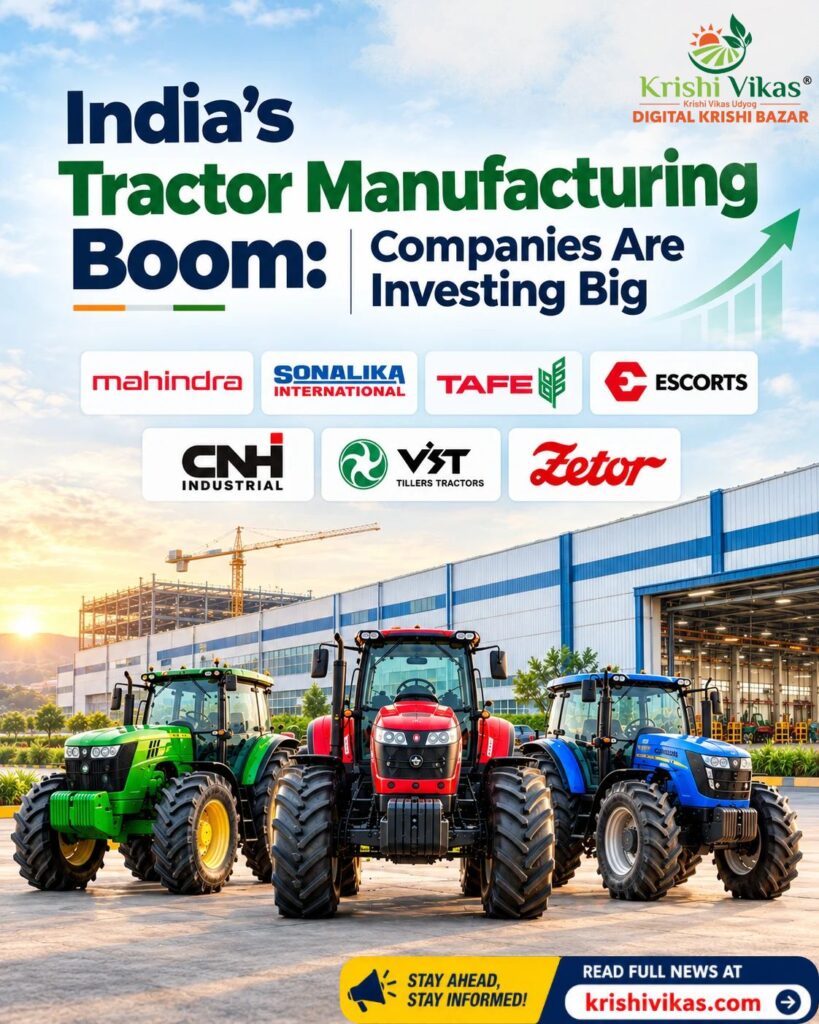
India’s tractor industry is entering a new phase. Over the past several months, major tractor and farm-equipment companies have announced large investments in new manufacturing plants, R&D centres, technology hubs and export-oriented facilities.
Mahindra is planning a ₹15,000 crore integrated manufacturing facility in Nagpur. Escorts Kubota has started work on a ₹2,000+ crore plant in Uttar Pradesh. TAFE is preparing its fifth tractor plant, while CNH India plans to double its tractor manufacturing capacity by 2030. ITL is expanding its global R&D capabilities and VST Tillers Tractors is investing in a new technology centre focused on next-generation farm machinery.
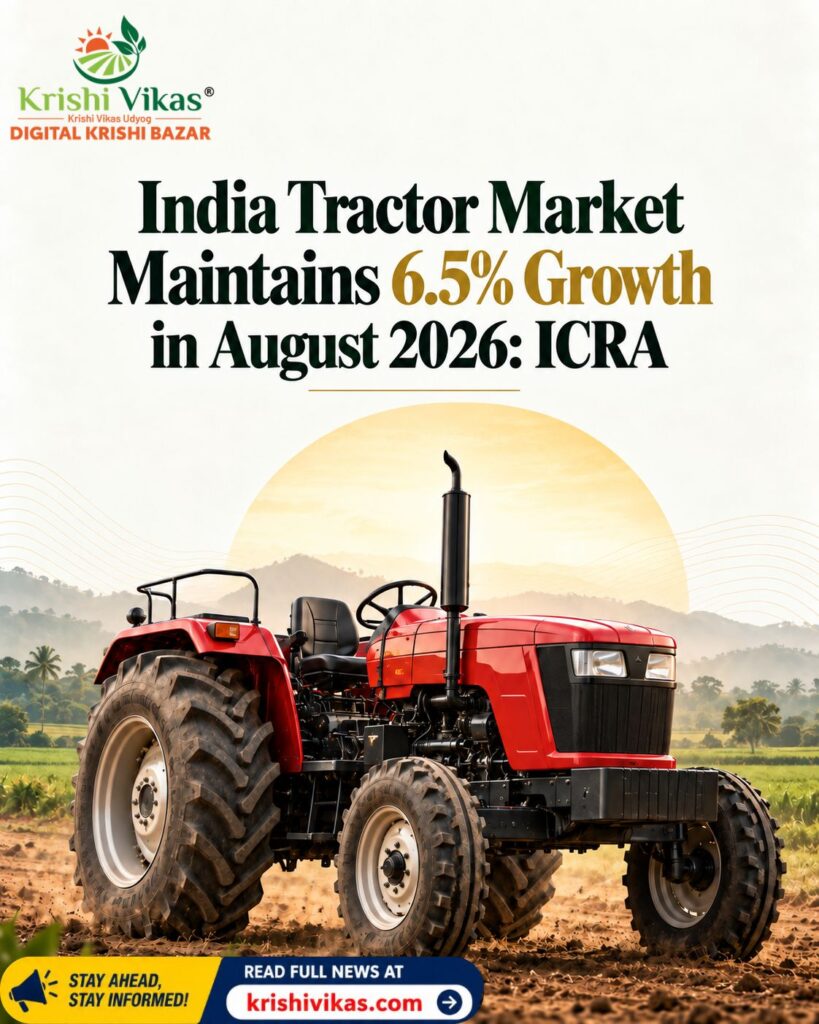
This is more than a series of individual corporate expansion plans. It indicates that India is becoming increasingly important not only as a tractor market, but also as a manufacturing, engineering and export base. Also read the India Tractor Market Maintains 6.5% Growth in August 2026: ICRA blog at Krishi Vikas.com.
India’s Tractor Market Has Crossed a Major Scale
One of the biggest reasons behind this investment cycle is the size and growth of India’s tractor market. Retail tractor sales reached 10,30,895 units in FY2025-26, registering an annual growth of 18.55%. That gives manufacturers a strong domestic demand base. But the opportunity is not limited to Indian farmers.
Companies are increasingly looking at India as a production base for tractors and farm machinery that can be exported to Asia, Africa, Europe, the Middle East, Latin America and other markets. This changes the economics of building a factory in India. A new plant does not necessarily exist only to supply Indian dealerships. It can become part of a company’s global manufacturing and supply-chain network.
The Investment Race: What Are Companies Actually Building?
Mahindra: Building Capacity for the Next Decade
Mahindra has announced a ₹15,000 crore investment for its largest integrated automobile and tractor manufacturing facility in Nagpur. The facility will cover around 1,500 acres, supported by a 150-acre supplier park in Sambhajinagar. Once fully operational, it is planned to produce more than 5 lakh vehicles and 1 lakh tractors annually, with production scheduled to begin in 2028.
The facility is being designed around advanced automation, digital manufacturing and multiple powertrain technologies. That creates flexibility for future product generations rather than simply adding another conventional production line.
Escorts Kubota: Domestic Demand Meets Export Ambition
Escorts Kubota has begun construction of a 154-acre greenfield manufacturing facility in Gautam Buddha Nagar, Uttar Pradesh, with an investment of more than ₹2,000 crore. The first phase is planned for an annual capacity of up to 60,000 tractors and 15,000 construction-equipment units. The plant is also expected to manufacture products for domestic and international markets.
The location itself is significant. The plant is being developed in the YEIDA industrial area near the Yamuna Expressway and Jewar airport, creating potential logistics advantages for both domestic distribution and exports.
TAFE: A New Tractor Plant After Nearly Three Decades
TAFE is preparing its fifth tractor manufacturing facility, backed by an investment of around ₹1,250 crore. The proposed north India facility is expected to have capacity for approximately 60,000 tractors annually. The investment follows a strong business year for TAFE, with revenue reaching around ₹16,000 crore.
TAFE has also expanded its engine manufacturing capabilities through its DEUTZ collaboration at Alwar. The bigger story here is capacity diversification. A new facility in north India can bring production closer to important agricultural markets while also supporting TAFE’s international expansion.
CNH India: India as a Global Export Base
CNH India has announced plans to invest around ₹2,000 crore by 2030, including approximately ₹1,000 crore for a new tractor manufacturing facility near Greater Noida. The company plans to increase tractor manufacturing capacity from around 70,000 to 1.4 lakh units annually. CNH also exports more than 11,000 tractors a year from India to markets including the US, Europe, the Middle East and Africa. This is particularly important because it demonstrates how Indian manufacturing is becoming integrated into global tractor supply chains.
ITL: Moving Beyond Manufacturing Into Engineering
International Tractors Limited is taking a different route. Instead of announcing only another production facility, ITL is developing a 25-acre Global R&D Centre in Greater Noida. The centre is intended to combine engineering capabilities with farmer insights to develop technologies and agricultural solutions for Indian and international markets.
This matters because the next phase of tractor competition will not be based only on horsepower. Manufacturers are increasingly working on: Fuel efficiency, precision agriculture, connected machines, advanced hydraulics, electronics, automation, alternative powertrains and application-specific implements.
VST: Investing in the Technology Behind the Machine
VST Tillers Tractors is investing around ₹100 crore in a Global Technology Centre at Hosur. The facility is designed to strengthen advanced engineering and R&D, with work covering tractors, tillers, farm mechanisation equipment and intelligent machinery using both ICE and EV drivetrains. This is an important signal from the compact and small-farm machinery segment.
India’s mechanisation requirement is not uniform. A farmer cultivating a few acres may need a very different machine from a large commercial farm. Compact tractors, power tillers, specialised implements and electric machines can therefore become increasingly important parts of the mechanisation ecosystem.
And Then There Is Zetor
Perhaps the most interesting development is coming from outside India. Czech tractor manufacturer Zetor has announced the end of tractor production at its Brno facility, while retaining its headquarters and development centre there. The company says two tractor models currently under development will be manufactured in India, with one expected to enter the European market. Zetor is also expanding its Indian project through its joint venture with VST.
This does not mean that all Zetor engineering is moving to India. Its Brno development centre remains operational. But the production shift is significant. Reuters reported that Zetor cited cost pressures in Europe and lower manufacturing costs in Asia as factors behind the move.
Why Are So Many Companies Expanding at the Same Time?
1. India Has a Large and Growing Tractor Market
Crossing the one-million-unit annual retail level gives manufacturers a substantial domestic market to build around. The FY2025-26 figure of 10.31 lakh tractors provides scale for new factories, suppliers and technology investments.
2. Exports Are Becoming More Important
Companies are increasingly using Indian plants to serve overseas markets. CNH, for example, already exports more than 11,000 tractors annually from India. That means production expansion can be driven by both Indian demand and international demand.
3. Tractor Manufacturing Is Becoming More Technology-Intensive
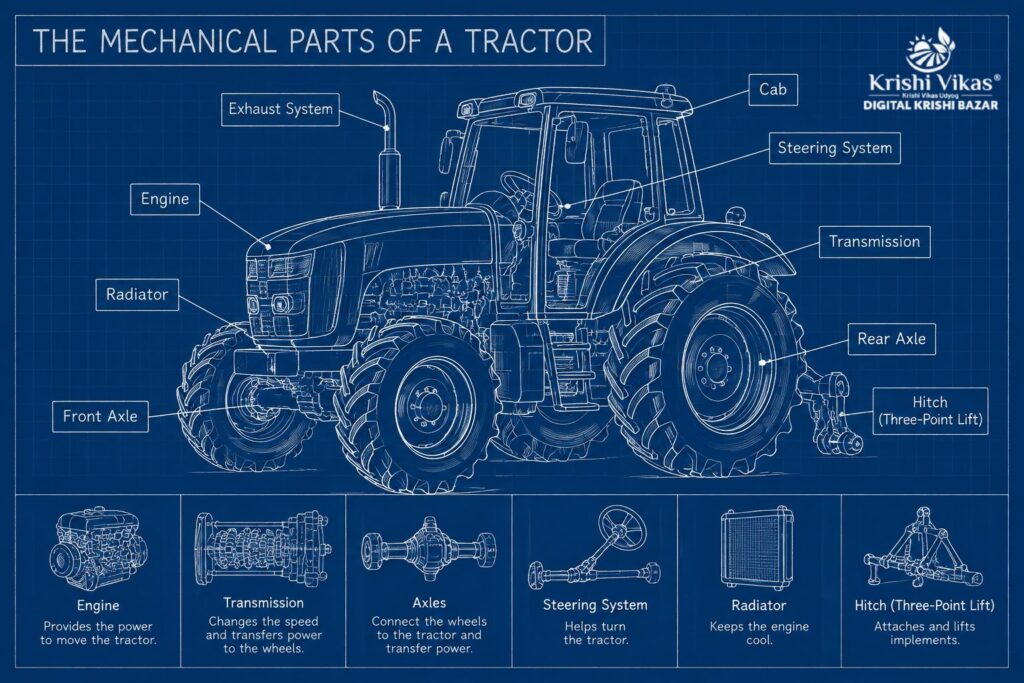
A modern tractor is no longer just an engine, gearbox, axle and hydraulic system. Manufacturers are investing in: electronics, sensors, digital controls, simulation, advanced testing, automation, connectivity, EV drivetrains and precision-farming technologies. The investments by ITL and VST in dedicated R&D infrastructure demonstrate this shift.
4. Companies Want Greater Manufacturing Flexibility
Large new plants allow manufacturers to introduce new platforms and production technologies without being restricted by older factory layouts. Mahindra’s planned Nagpur facility, for example, is being designed around multiple powertrain technologies and digital manufacturing systems.
5. India Is Becoming More Important in Global Supply Chains
New plants can bring suppliers, component manufacturers, logistics companies, testing facilities and skilled engineering jobs closer together.
This creates an ecosystem rather than simply another factory.
The Bigger Shift: From Tractor Manufacturing to Farm-Mechanisation Ecosystem
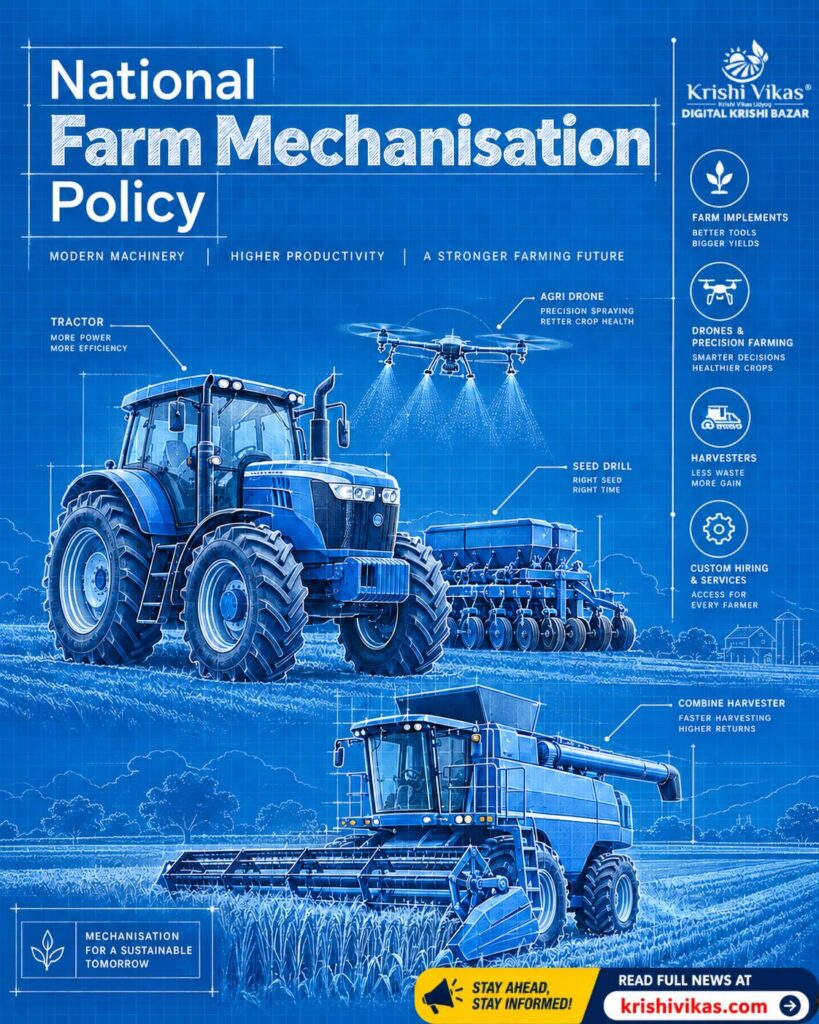
This is perhaps the most important development. The investment cycle is not only about building more tractors. Companies are investing across the wider mechanisation chain:
Tractors → Implements → Engines → Electronics → EVs → R&D → Testing → Digital Manufacturing → Exports
That creates the possibility of a much broader Indian farm-equipment ecosystem.
For farmers, this could eventually mean that tractor selection becomes less about simply asking “Which tractor has more HP?”
Instead, the decision may increasingly involve: Which powertrain suits my farm? Which implements will I use? What level of hydraulics do I need? What is the operating cost? Where is the nearest service centre? What financing is available? And what technology will remain useful over the next 5–10 years?
Krishi Vikas Perspective: India Is Building for the Next Tractor Cycle
The current investment wave should be viewed as a long-term capacity and technology build-out, rather than proof that tractor demand will grow at the same rate every year. The FY2025-26 retail market crossed 10.3 lakh tractors, but future demand will still depend on factors such as farm incomes, monsoon conditions, rural credit, replacement demand, government mechanisation support and overall agricultural activity.
What is clearer is the direction of industry investment – Manufacturing capacity is expanding. R&D infrastructure is expanding. Export ambitions are expanding. Technology capabilities are expanding.
For farmers, the real benefit will come when this investment reaches the field in the form of more suitable machines, better fuel efficiency, improved implements, stronger service networks and useful technology at practical ownership costs.
For India, the opportunity is even broader: to move from being one of the world’s largest tractor markets to becoming one of the world’s most important tractor engineering, manufacturing and export hubs. And that is why these new plants matter. They are not just factories for today’s tractors. They are infrastructure for the next generation of Indian farm mechanisation.
Krishi Vikas is a Digital Krishi Bazar and we offer agricultural services like Buy/Sell/Rent tractors, harvesters, goods vehicles & agri-equipment. Please contact us for more information.
Subscribe to our Youtube Channel – https://www.youtube.com/@JoinKrishiVikas
Follow us for Latest Tractor Industry Updates!
LinkedIn – https://www.linkedin.com/company/joinkrishivikas/
Facebook – https://www.facebook.com/joinkrishivikas
Instagram – https://www.instagram.com/joinkrishivikas/
Download the Krishi Vikas App now!
Play Store – https://play.google.com/store/apps/details?id=com.krishivikas.android&pcampaignid=web_share
App Store – https://apps.apple.com/in/app/krishi-vikas-udyog-kisan-app/id6449253442