NITI Aayog Vice Chairman Calls for Technology-Driven, Market-Focused Agriculture
Farmers Should be Businessmen Who Respond to Market Demand – NITI Aayog Vice Chairman Ashok Lahiri has called for a fundamental shift in Indian agriculture from a production focused approach to a technology driven, value added and globally competitive agri-food system.
Speaking on Thursday, Lahiri stressed that India needs to move from a mindset of simply increasing farm output to one focused on raising farmer prosperity, improving productivity and responding to changing market demand. Also read RBI Flags El Niño Risk: Krishi Vikas Viewpoint blog at Krishi Vikas.com.

Technology Key to Raising Farm Productivity
Lahiri highlighted the gap between India’s agricultural productivity and global benchmarks, noting that yields per acre for several major crops remain significantly lower. Greater adoption of science and technology can help farmers increase productivity while reducing input costs. Technologies such as high-yielding hybrid seeds, precision agriculture, improved fertiliser and water management, artificial intelligence, drones, remote sensing and satellite imagery can play an important role in this transition. Technology should not be viewed simply as a way to increase production, but as a tool to make farming more efficient, profitable and resilient.
From Production to Prosperity
A major part of the transformation, Lahiri said, is diversifying agriculture beyond traditional cereals. As incomes rise and consumer preferences change, demand is increasingly shifting towards milk and dairy products, fresh fruits and vegetables, eggs, fish, meat and processed food.
“Supply needs to adjust to changing demand,” Lahiri said, emphasising that farmers should increasingly produce what consumers want today rather than focusing solely on crops that were prioritised to address shortages decades ago. This could create greater opportunities in horticulture, poultry, fisheries, goat rearing and agroforestry, alongside traditional crop cultivation.
Fertiliser Imbalance Remains a Concern
Lahiri also highlighted India’s growing imbalance in fertiliser use. India’s average nitrogen-phosphorus-potassium (NPK) ratio stands at around 9.8:3.7:1, compared with the recommended ratio of 4:2:1. Excessive nitrogen use partly to the differential subsidy structure that makes urea relatively inexpensive. Overuse of nitrogen, he said, is affecting soil health and ultimately agricultural productivity. He also called for faster action to address the imbalance, while acknowledging that the issue has become difficult to resolve because of its wider socio-economic and socio-political implications.
Connecting Indian Agriculture With Global Markets
Lahiri also stressed the importance of giving Indian agricultural products a stronger presence in international markets. India produces globally recognised agricultural products, including premium mango varieties, but their presence in major overseas markets remains limited.
He called for greater efforts to take specialised, high-value Indian agricultural products to global consumers. At the same time, India needs to move beyond exporting raw agricultural commodities and focus more on processing and value addition. For instance, converting pineapple into ready-to-consume products can increase the value generated from the crop while creating employment and reducing post-harvest losses.
Reducing Post-Harvest Losses
Lahiri estimated that India loses around $18.5 billion annually due to agricultural produce wastage, while fruits and vegetables can experience post-harvest losses of approximately 15% to 18% before reaching markets. Post-harvest losses remain a major challenge for Indian agriculture. He stressed the need for greater investment in cold storage, transportation and supply-chain infrastructure to reduce wastage and ensure farmers receive better returns.
Stronger FPOs Can Improve Farmer Bargaining Power
Lahiri also highlighted the importance of strengthening Farmer Producer Organisations (FPOs).
Small and marginal farmers often face difficulties in accessing quality inputs, finance, technology, information and profitable markets because of their limited scale. Strong FPOs can help farmers aggregate their produce, negotiate better, access quality inputs and establish stronger connections with processors, retailers and other buyers.In this way, collective organisation can help small farmers gain some of the advantages enjoyed by larger agricultural businesses.
Climate-Smart Agriculture Is the Next Step
Lahiri also called for a move away from input-intensive farming towards climate-smart and sustainable agriculture. He raised concerns about the potential overuse of groundwater through solar-powered irrigation pumps, particularly when surplus electricity generated by these systems is not connected to the power grid. Connecting solar irrigation systems to the grid could allow farmers to sell surplus electricity, creating an additional source of income while encouraging more responsible groundwater use.
Digital Technology Can Transform Farming
Lahiri pointed to India’s digital public infrastructure and Digital Agriculture Mission as important foundations for building a data-driven and farmer-centric agricultural ecosystem. Digital technology is expected to play a central role in India’s agricultural transformation. Technologies such as AI, drones, remote sensing, satellite imagery, the Internet of Things and precision agriculture can help farmers:
- Improve crop productivity
- Optimise fertiliser and water use
- Reduce input costs
- Monitor crops more effectively
- Respond to weather risks
- Improve resource efficiency
- Strengthen climate resilience
However, Lahiri stressed that technology alone will not be enough. Effective implementation and stronger agricultural extension services are equally important.
Government Support and Better Extension Services
Lahiri noted that initiatives announced in the Union Budget 2026-27, along with national missions focused on fruits, vegetables, pulses, coconut and cashew and programmes supporting food processing, can contribute to building a more resilient agricultural economy. He also called for stronger extension services to ensure farmers understand how to use modern technologies and agricultural inputs effectively and suggested that fertiliser and pesticide companies could play a greater role in educating farmers about appropriate input use, creating a stronger link between agricultural knowledge, responsible input consumption and business opportunities. Farmers Should be Businessmen Who Respond to Market Demand.
Krishi Vikas Viewpoint: Farmers Need to Think Beyond Production
Lahiri’s message points to a larger transformation taking place in Indian agriculture: farmers need to become more market-oriented and business-focused.
The future of farming cannot depend only on producing more rice and wheat. Farmers need better access to information, machinery, technology, markets, storage, processing and financing to decide what to grow, how to produce it efficiently and where to sell it.
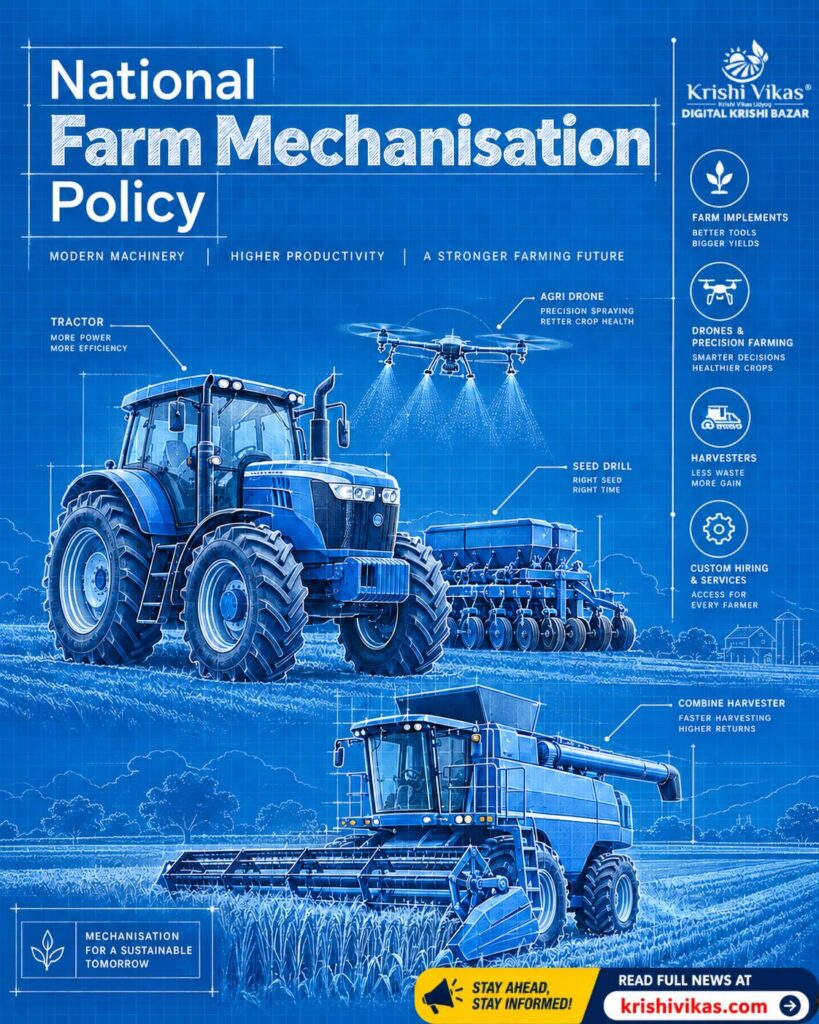
For farmers, this means treating machinery and technology as business tools rather than simply production assets. Access to tractors, harvesters, drones and other farm equipment—whether through ownership, rental or custom hiring—can help farmers improve efficiency without always requiring heavy upfront investment.
For platforms such as Krishi Vikas, this shift creates an opportunity to connect farmers with the machinery, technology and agricultural services they need to make better business decisions. The broader goal is clear: Indian agriculture must move from food production alone towards farmer prosperity, value creation and global competitiveness.