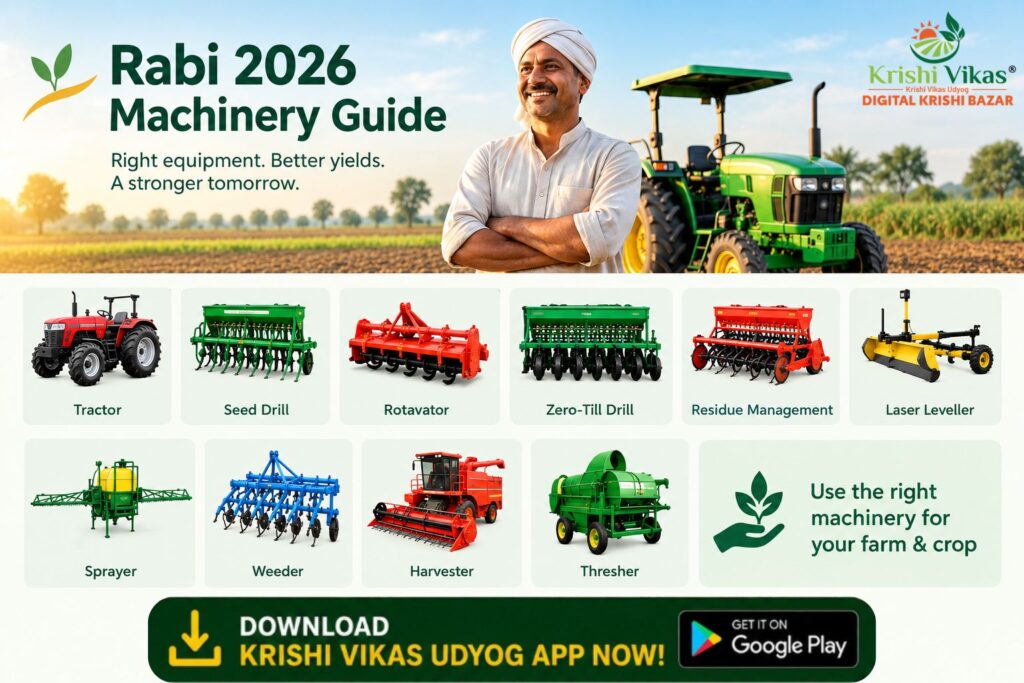
Choosing the right farm implement is just as important as choosing the right tractor. The correct implements can reduce labour requirements, save fuel, improve field efficiency, and help farmers complete operations on time. But there is no single implement that works equally well for every crop or farm size. A farmer growing rice on 5 acres will have very different machinery requirements from a farmer cultivating wheat on 50 acres. Soil type, crop, acreage, tractor horsepower, field conditions, and the type of operation all influence the right choice. This guide explains how farmers can select farm implements based on crop, acreage, tractor HP, and farming requirements. How to Select Farm Implements Based on Crop and Acreage. Also read Top 10 Modern Farming Implements blog at Krishi Vikas.com.
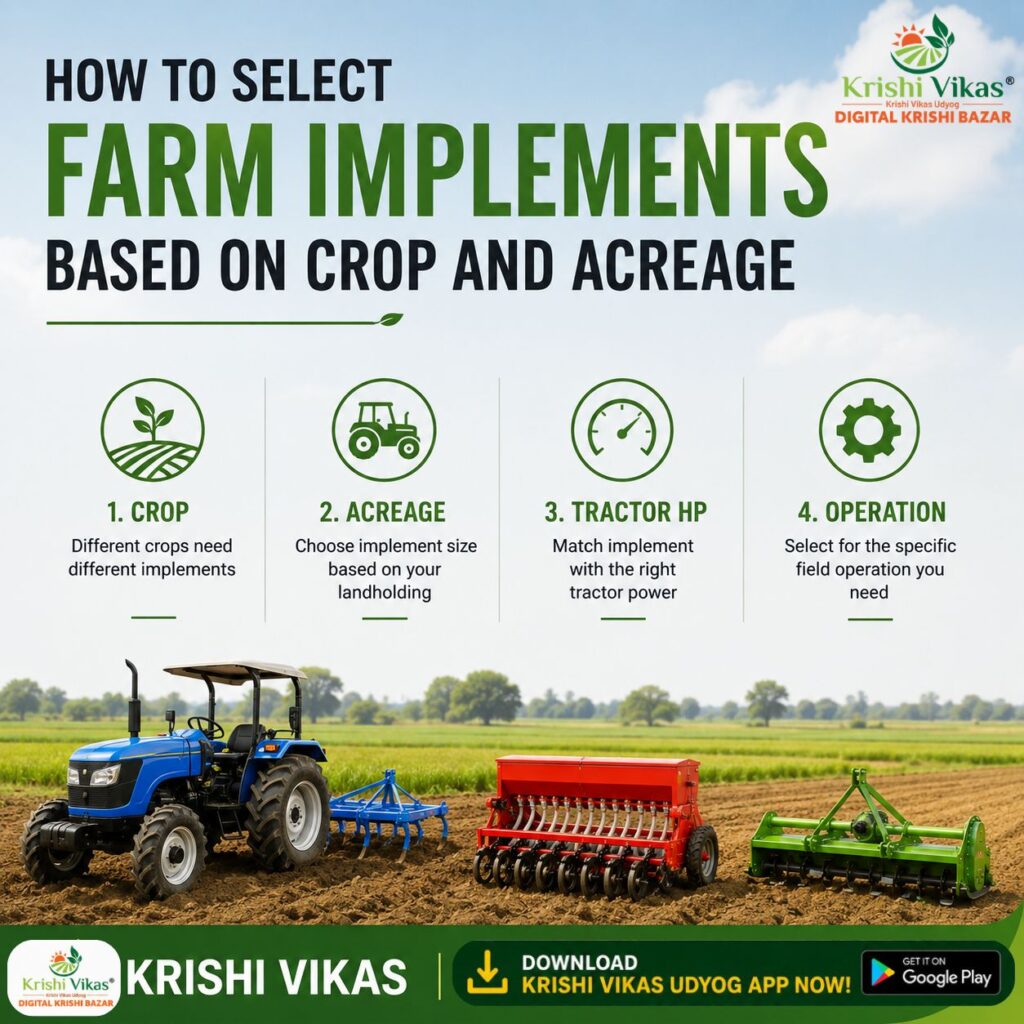
Choosing the Right Farm Implement
Farm implements are designed for specific agricultural operations such as tillage, sowing, planting, harvesting, spraying, and residue management. Using an undersized implement can increase operating time and fuel consumption, while an oversized implement can increase investment and tractor load unnecessarily. The objective should not simply be to buy the biggest or most powerful implement. It should be to select the implement that matches the crop, farm size and tractor.
The right implement can help farmers:
- Complete farm operations faster
- Reduce dependence on manual labour
- Improve soil preparation
- Maintain uniform seed placement
- Reduce fuel consumption per acre
- Improve crop establishment
- Handle crop residue efficiently
- Increase tractor utilisation
- Reduce overall operating costs
1. Crops
Rice
Rice cultivation often requires puddling, field preparation, transplanting or direct seeding, and residue management. For wet and puddled fields, specialised paddy equipment can be more useful than conventional dryland implements.
Useful implements may include:
- Paddy puddler
- Rotavator
- Cultivator
- Disc harrow
- Seed drill
- Paddy transplanter
- Reaper or combine harvester
- Straw management equipment
Wheat
Wheat generally requires proper seedbed preparation and timely sowing. A zero-till drill can be particularly useful where farmers want to establish wheat directly after a previous crop without extensive conventional tillage.
Common implements include:
- Rotavator
- Cultivator
- Disc harrow
- Seed drill
- Zero-till drill
- Fertiliser broadcaster
- Straw reaper
Maize
Maize requires precise sowing and effective weed management. For larger maize farms, mechanised planting and harvesting can significantly improve timeliness.
Suitable implements include:
- Rotavator
- Cultivator
- Maize planter
- Seed-cum-fertiliser drill
- Inter-cultivator
- Sprayer
- Maize harvester
Sugarcane
Sugarcane involves intensive land preparation, planting, earthing-up, interculture and harvesting. Because sugarcane remains in the field for a long period, appropriate intercultural and earthing-up equipment can be particularly valuable.
Farmers may require:
- Disc plough
- Cultivator
- Rotavator
- Sugarcane planter
- Ridger
- Inter-cultivator
- Sugarcane harvester
Pulses and Oilseeds
Crops such as soybean, chickpea, mustard and pigeon pea generally require implements suited to seed placement, weed management and harvesting.
Depending on the crop, farmers may consider:
- Seed drill
- Zero-till drill
- Cultivator
- Rotavator
- Inter-cultivator
- Sprayer
- Reaper
2. Farm Acreage
1–5 Acres
For very small farms, purchasing several specialised implements may not always be economical. A smaller rotavator, cultivator or seed drill matched to the tractor can be sufficient for many operations. Best approach: prioritise versatile implements and consider renting specialised machinery.
Farmers should consider:
- Compact implements
- Multi-purpose implements
- Tractor-mounted equipment
- Equipment available through rental or custom hiring
5–10 Acres
Farmers in this category can benefit from owning commonly used implements while renting equipment that is used only occasionally. For specialised harvesting equipment, rental or custom hiring can often be more practical than ownership.
Potential equipment includes:
- Rotavator
- Cultivator
- Seed drill
- Sprayer
- Trailer
- Ridger
10–25 Acres
At this level, timely completion becomes increasingly important. The choice should be based on annual usage rather than acreage alone.
Farmers may consider investing in:
- Rotavator
- Disc harrow
- Cultivator
- Seed drill
- Planter
- Sprayer
- Trailer
- Inter-cultivator
25+ Acres
Larger farms generally benefit from higher-capacity implements because delays during sowing, spraying or harvesting can affect the entire operation. However, tractor horsepower must be sufficient to operate these implements effectively.
Depending on the crop, farmers may consider:
- Heavy-duty tillage equipment
- Larger seed drills
- Multi-row planters
- High-capacity sprayers
- Reapers
- Combine harvesters
- Straw management equipment
3. Match the Implement With Tractor Horsepower
One of the most important mistakes farmers can make is purchasing an implement without checking tractor compatibility. Every implement has a recommended power requirement. A tractor that is too small may struggle to pull the implement, while excessive horsepower may result in inefficient utilisation.
| Tractor HP | Common Implement Applications |
| 20–30 HP | Light cultivator, small rotavator, sprayer, small seed drill |
| 30–40 HP | Cultivator, rotavator, seed drill, trailer, small harrow |
| 40–50 HP | Larger rotavator, disc harrow, seed drill, planter, ridger |
| 50–60 HP | Heavy tillage, larger planters, specialised implements |
| 60+ HP | Heavy-duty tillage, high-capacity planters and large farm machinery |
4. Select Implements According to the Farming Operation
Land Preparation
For hard or compacted soil, deeper tillage equipment may be required. For routine seedbed preparation, a cultivator or rotavator may be sufficient.
Common implements include:
- Disc plough
- Cultivator
- Disc harrow
- Rotavator
- Subsoiler
Sowing and Planting
Precision planting equipment becomes particularly valuable for crops where uniform spacing and seed placement affect yield.
Farmers can choose from:
- Seed drill
- Zero-till drill
- Seed-cum-fertiliser drill
- Planter
- Paddy transplanter
Weed Management
The right choice depends on crop spacing, row arrangement and the stage of crop growth.
Common options include:
- Inter-cultivator
- Mechanical weeders
- Power weeders
- Sprayers
Spraying
For small farms, tractor-mounted or battery-powered sprayers may be sufficient. The objective is to achieve uniform application while covering the required area quickly.
For larger farms, farmers can consider:
- Boom sprayers
- Tractor-mounted sprayers
- High-capacity sprayers
Harvesting and Residue Management
Residue management equipment can become particularly important where farmers need to prepare fields quickly for the next crop.
Depending on the crop, farmers may need:
- Reaper
- Combine harvester
- Straw reaper
- Baler
- Mulcher
- Super Seeder
5. Soil Type and Field Conditions
Heavy Clay Soil
Heavy soils may require stronger tillage equipment and adequate tractor power.
Sandy Soil
Sandy soils generally require less draft than heavy clay soils, so excessively large implements may not be necessary.
Wet Fields
For paddy cultivation and other wet conditions, farmers should consider implements specifically designed for wet-field operations.
Hard or Compacted Soil
A subsoiler or suitable deep-tillage implement may be required where compaction is a recurring problem. Farmers should therefore evaluate soil texture, moisture and field condition before choosing an implement.
6. Consider Implement Width
Implement width directly affects field capacity. A wider implement can cover more area per pass, potentially reducing operating time. However, it also requires greater tractor power and may not be suitable for small or irregularly shaped fields. For example, a farmer with small plots and narrow field access may find a compact implement more practical than a large implement, even if the tractor has sufficient horsepower.
The ideal width should match:
- Tractor HP
- Field size
- Field shape
- Soil condition
- Road and gate access
- Required operating speed
7. Calculate the Economics Before Buying
Before purchasing an implement, calculate how often it will be used. A simple calculation is: Annual machinery cost ÷ annual area covered = machinery cost per acre
If an implement is used only a few days each year, renting it may be more economical. If it is used repeatedly across multiple crops, ownership may make more financial sense.
Farmers should consider:
- Purchase price
- Fuel consumption
- Maintenance
- Repairs
- Depreciation
- Labour savings
- Annual usage
- Expected resale value
8. Ownership vs Rental: Which Should Farmers Choose?
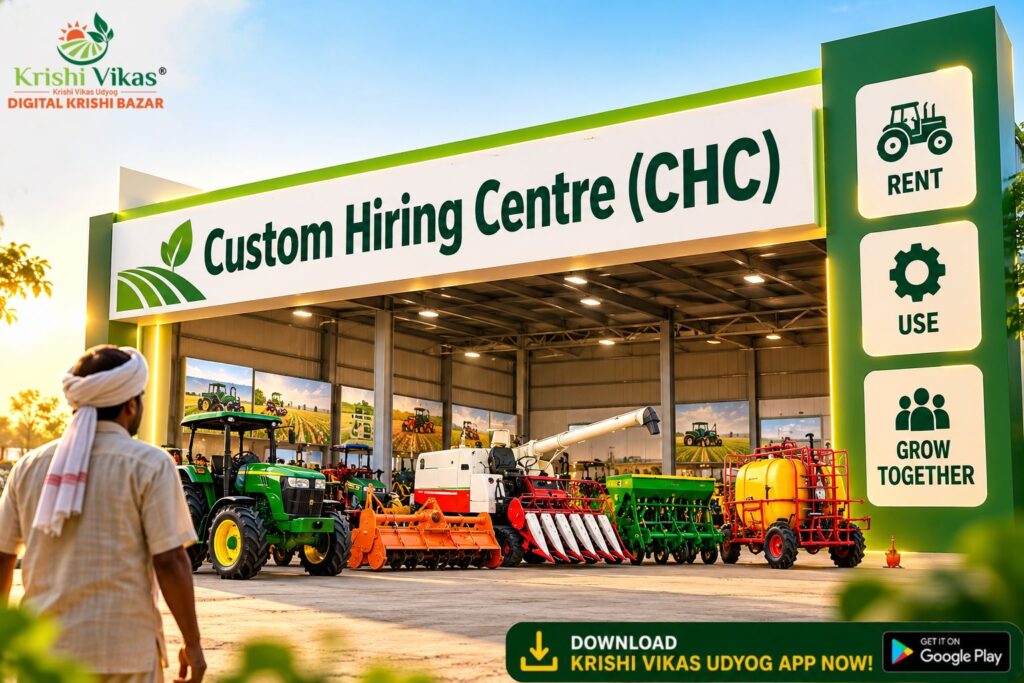
For small and medium farmers, renting machinery can be an effective way to access expensive equipment without making a large upfront investment.
Buying may make sense when:
- The implement is used frequently
- The farmer cultivates multiple crops
- There is sufficient acreage
- Rental availability is limited
- The implement can generate additional income through rental
Renting may make sense when:
- The implement is used only occasionally
- The machinery is expensive
- Farm acreage is small
- A specialised machine is needed for only one crop
- Local machinery rental is easily available
Krishi Vikas Viewpoint
Farm mechanisation is not simply about owning more machinery. It is about accessing the right machinery at the right time. For a farmer cultivating five acres, purchasing every specialised implement may not be financially practical. For a larger farmer, however, delays caused by limited machinery access can affect the entire cropping cycle. This makes machinery rental, custom hiring and shared equipment access increasingly important for Indian agriculture. The future of farm mechanisation will therefore not be defined only by bigger tractors or advanced implements. It will also depend on making modern machinery affordable, accessible and available when farmers need it. How to Select Farm Implements Based on Crop and Acreage.
Final Takeaway
The right farm implement depends on a combination of crop, acreage, soil, tractor HP, field conditions and economics. Before making a purchase, farmers should first identify the operation they need to mechanise and then select equipment that matches their actual requirements. The best implement isn’t necessarily the biggest one—it is the one that delivers the right work at the lowest practical cost per acre. For farmers who cannot justify purchasing specialised machinery, rental and custom hiring can provide a cost-effective way to access modern farm equipment without the burden of ownership. How to Select Farm Implements Based on Crop and Acreage.