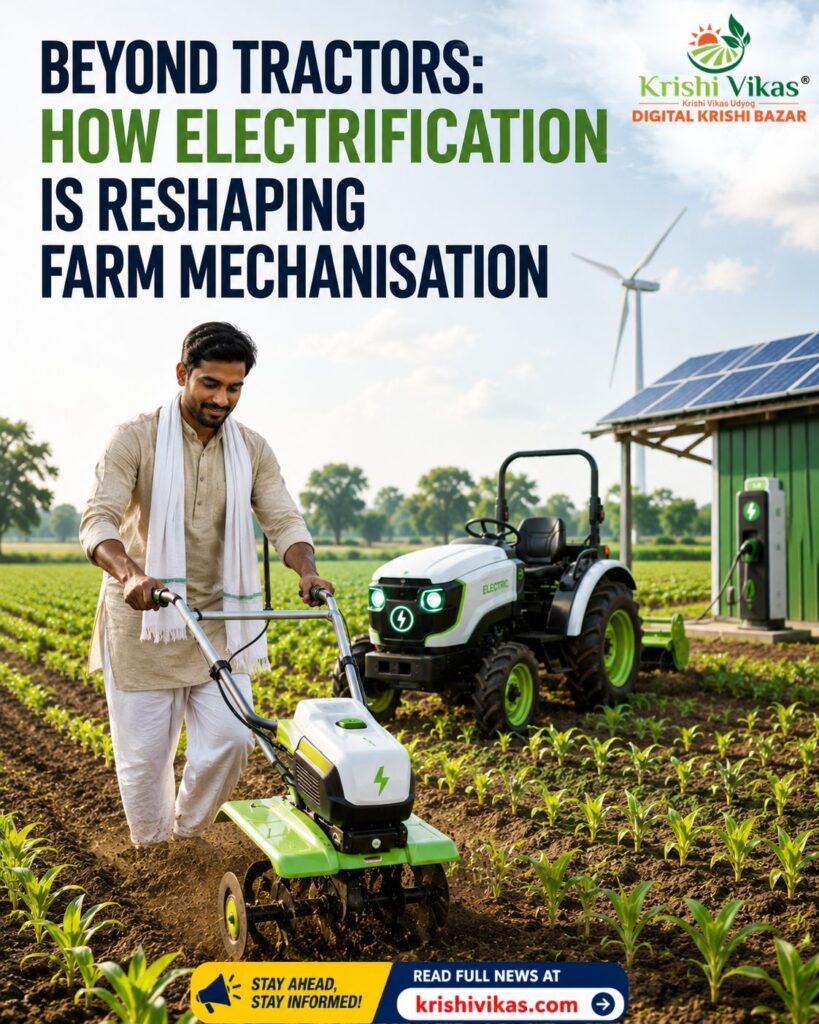
Beyond Tractors: How Electrification Is Reshaping Farm Mechanisation
India has just recorded its strongest tractor year on record. Domestic tractor wholesales reached 11,60,231 units in FY26, registering 23.5% growth, while retail volumes crossed the 10-lakh mark for the first time. By the conventional measure of the industry, this signals rapid agricultural mechanisation. India’s overall farm mechanisation level remains around 47%, compared with approximately 60% in China and 75% in Brazil. A Parliamentary committee has noted that, at the current pace, India could take nearly 25 years to reach 75–80% mechanisation. The underlying challenge is structural. Around 86% of India’s operational landholdings are smaller than two hectares. For many of these farmers, owning and operating a conventional 45 HP tractor may not be the most practical or economical solution. The real growth story may therefore be emerging elsewhere in the machinery market. India’s Next Farm Mechanisation Wave May Not Be Driven by Tractors.Also read Farmers Should be Businessmen Who Respond to Market Demand blog at Krishi Vikas.com.
Small Machinery Is Gaining Momentum
India’s small-farm machinery segment is expanding rapidly. One of the country’s leading manufacturers of compact agricultural equipment sold more than 11,000 power weeders in FY26, representing 52% growth, while reaper volumes increased by 44%. This compares with 18.6% growth in its domestic tractor business.
The numbers point toward a broader shift: some of the fastest-growing opportunities in Indian farm mechanisation are concentrated in compact machines in the 1.5–7 kW range, including equipment that can be operated by a single person. This segment is particularly relevant to India’s small and fragmented farms.
Why Electrification Could Start From the Bottom
Electrification is increasingly entering agriculture through this compact-equipment segment rather than beginning with large tractors.
In November 2025, a major Indian manufacturer introduced its first electric power tiller and power weeder, while smaller manufacturers have already been offering battery-powered weeders.
Large electric agricultural machines such as self-propelled combines and boom sprayers remain commercially challenging because of their high energy requirements. Compact machines, however, operate within a much more manageable power range.
Electric motors can deliver high torque at low speeds, making them useful for operations that require sudden increases in load. They also provide precise speed control, which can be valuable for inter-row operations.
For workers operating machinery for several hours, lower noise and vibration can also make a meaningful difference. In enclosed environments such as polyhouses, the absence of direct exhaust emissions is another potential advantage.
Policy Is Supporting the Shift
Government initiatives are also expanding access to agricultural mechanisation. Under the Sub-Mission on Agricultural Mechanisation (SMAM), around ₹9,404 crore has reportedly been released since 2014–15, supporting the establishment of more than 27,500 Custom Hiring Centres and 25,600 Farm Machinery Banks. The reduction of GST on farm machinery to 5% in September 2025 has also lowered the upfront cost of several categories of agricultural equipment.
Meanwhile, PM-KUSUM has accelerated the deployment of solar-powered irrigation, with more than 10.9 lakh standalone solar pumps reported under the scheme. These developments matter because electrification becomes more attractive when agricultural machinery can be connected to locally generated renewable power.
The Real Challenge Is System Integration
The biggest challenge in electric farm machinery may not simply be battery technology or motor availability. It is system integration.
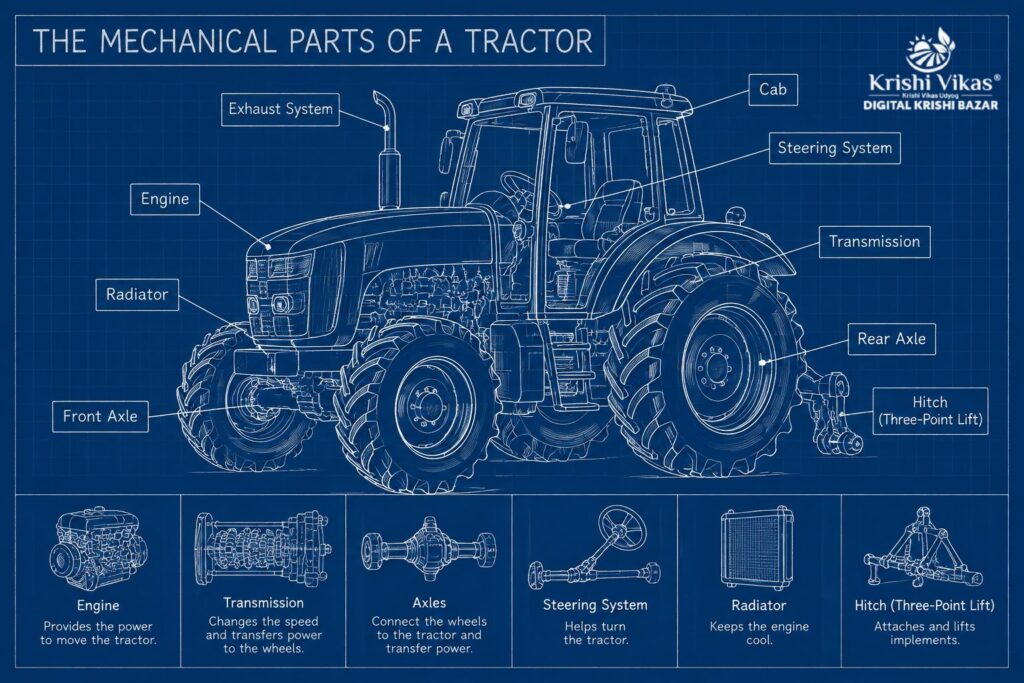
A machine’s real-world performance depends on the interaction between:
- Electric motor
- Controller
- Battery pack
- Cooling system
- Power electronics
- Software and control logic
- Mechanical transmission
Rated motor power alone does not tell the complete story. A motor that performs well under laboratory conditions can behave differently in a field environment involving high temperatures, continuous loads, dust and changing soil resistance. Manufacturers therefore need to engineer electric machines around actual agricultural duty cycles, rather than simply adapting components designed for other applications.
Import Dependence Adds Another Layer
A significant share of India’s agricultural machinery imports comes from China, giving imported components a substantial cost advantage in several categories. Reducing this dependence will require more than replacing individual imported components with domestic alternatives.
The larger opportunity lies in developing complete, integrated electric agricultural machines in India. Manufacturers that can bring together the motor, controller, battery, cooling system and mechanical platform around real farm requirements could have a significant competitive advantage.
Krishi Vikas Viewpoint
At Krishi Vikas, we believe the next phase of agricultural mechanisation should focus on access rather than ownership alone.
India’s small and fragmented landholdings mean that every farmer may not need to own a tractor or expensive machinery. What matters is having access to the right equipment at the right time and at an affordable cost. This is where machinery rental, custom hiring and digital access to farm equipment can play a major role.
Electric machinery could further expand these opportunities. Compact electric power weeders, tillers and specialised implements may be particularly relevant for small farms, horticulture, inter-row operations and other applications where conventional large machinery is not always economical.
Krishi Vikas sees the future as a combination of:
Tractors + Compact Machinery + Electric Equipment + Rental Access + Digital Technology
The goal is not to replace conventional tractors overnight. It is to give farmers more choices and better access to mechanisation.
The Next Decade Will Be About More Than Tractor Sales
India’s record tractor sales are an important indicator of growing mechanisation demand, but they do not tell the complete story. The next phase will require machinery that is compact, affordable, versatile, efficient and accessible. Electrification can become an important part of that transition, particularly in smaller agricultural equipment.
The future of Indian farm mechanisation will therefore not be measured only by the number of tractors sold. It will also be measured by how effectively technology reaches India’s smallest farms. And the next big shift may not be about making tractors bigger. It may be about making farm machinery smaller, smarter, more accessible—and increasingly electric. India’s Next Farm Mechanisation Wave May Not Be Driven by Tractors.