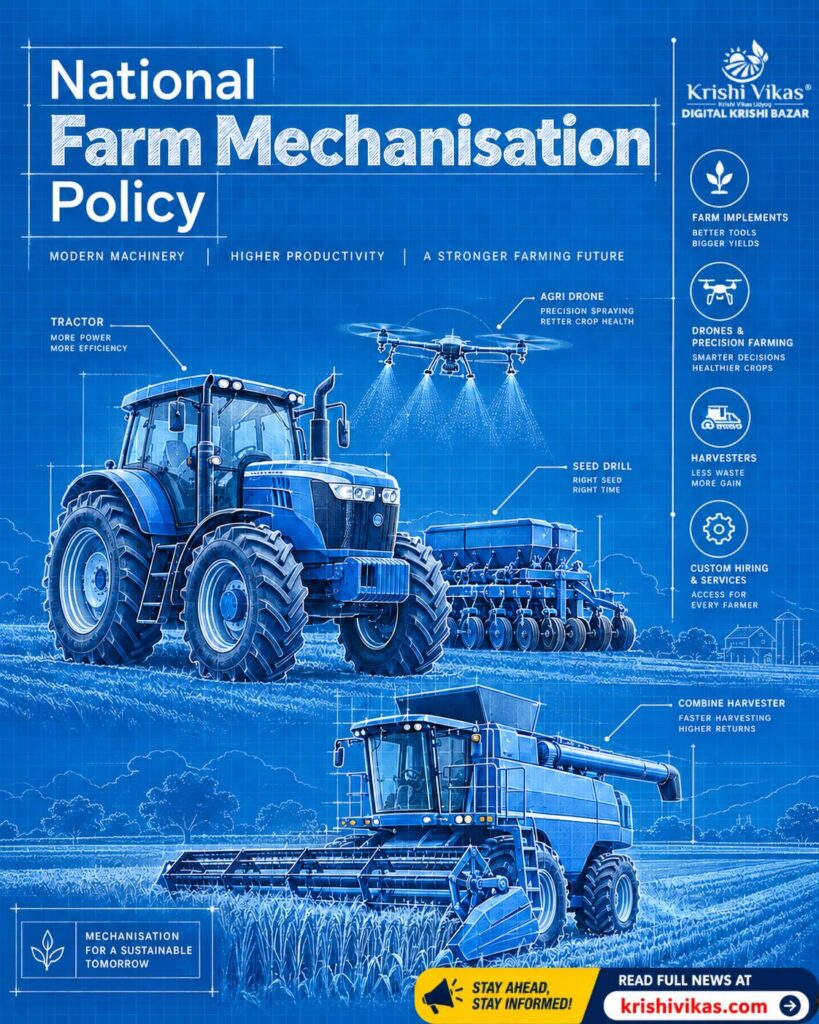
Fuel efficiency is one of the most important factors farmers consider when buying a tractor in 2026. Diesel is a major operating expense, particularly for farmers using tractors for several hours every day for ploughing, rotavating, sowing, haulage and other field operations. However, comparing tractors only by a claimed “mileage” figure can be misleading. Tractor fuel consumption changes with load, soil condition, implement size, engine speed, tyre configuration, driving habits and maintenance. Manufacturers increasingly focus on engine design, torque delivery, transmission options and PTO efficiency to help farmers get more work from every litre of diesel. The tractor models ranked by fuel efficiency guide compares some popular tractor models on their published efficiency-related specifications and features and explains what farmers should consider before choosing a fuel-efficient tractor. Also read the Best Compact Tractors for Small Farms (5–10 Acres) blog at Krishi Vikas.com.
Fuel-Efficient Tractors in 2026
| Rank | Tractor Model | HP Category | Key Efficiency Highlight | Best Suited For |
| 1 | Mahindra 575 DI XP Plus | 47 HP | Low SFC of 185 g/hp-hr | Tillage, haulage, multipurpose farming |
| 2 | New Holland 3630 TX Super | 50 HP | Manufacturer claims best-in-class mileage | General farming and heavy implements |
| 3 | Sonalika DI 745 III | Around 50 HP | 3-cylinder engine, 1900 RPM | Tillage, wetland farming, haulage |
| 4 | John Deere 5310 | 57 HP | Economy PTO option at 1600 RPM | Multipurpose and commercial farming |
| 5 | Swaraj 855 FE | 46–50 HP | 3-cylinder design and established efficiency focus | Heavy-duty field work |
1. Mahindra 575 DI XP Plus
The Mahindra 575 DI XP Plus is one of the strongest options for farmers looking for a combination of performance and fuel efficiency in the 45–50 HP segment. Mahindra’s published specifications list a 33 kW (45 HP) four-cylinder ELS DI engine, 210 Nm of maximum torque and a rated speed of 1500 RPM. More importantly for fuel consumption, Mahindra has reported a specific fuel consumption (SFC) of 185 g/hp-hr, a useful technical indicator for comparing engine fuel efficiency. The tractor also offers a 1,800 kg hydraulic lifting capacity and 39.6 HP PTO power, making it suitable for implements such as cultivators, rotavators, seed drills and threshers. Best for: Farmers who want a versatile tractor for regular field operations while keeping fuel efficiency in focus.
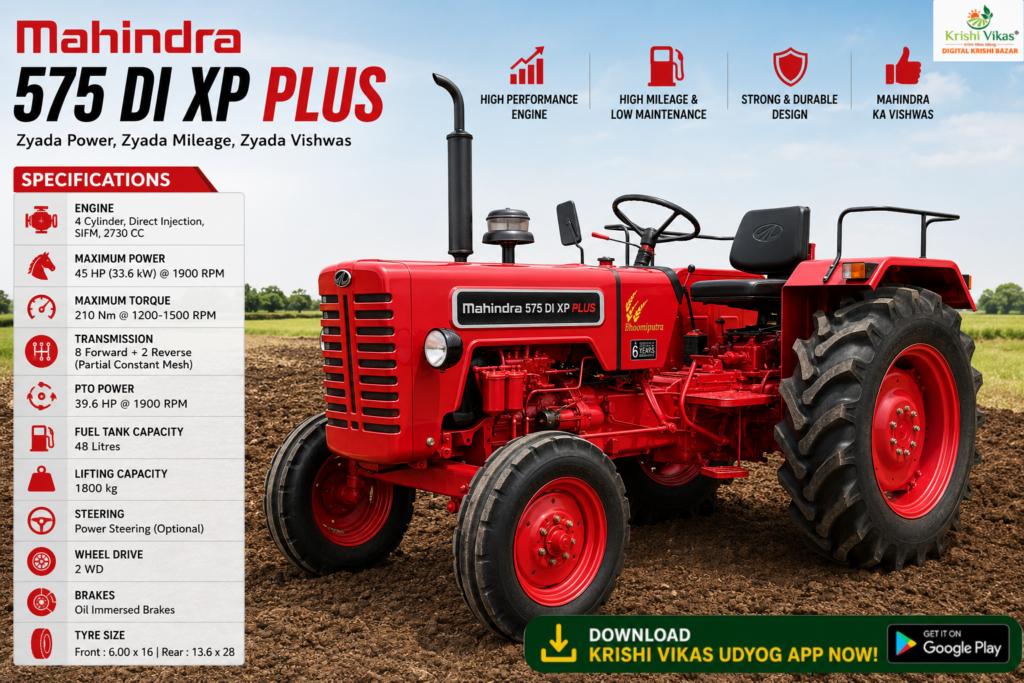
2. New Holland 3630 TX Super
The New Holland 3630 TX Super is a popular 50 HP tractor designed for demanding agricultural applications. It features a 3-cylinder diesel engine, strong torque output and a robust transmission designed for field and haulage operations. Best for: Farmers looking for a versatile 50 HP tractor for regular field operations and heavy-duty implement work.
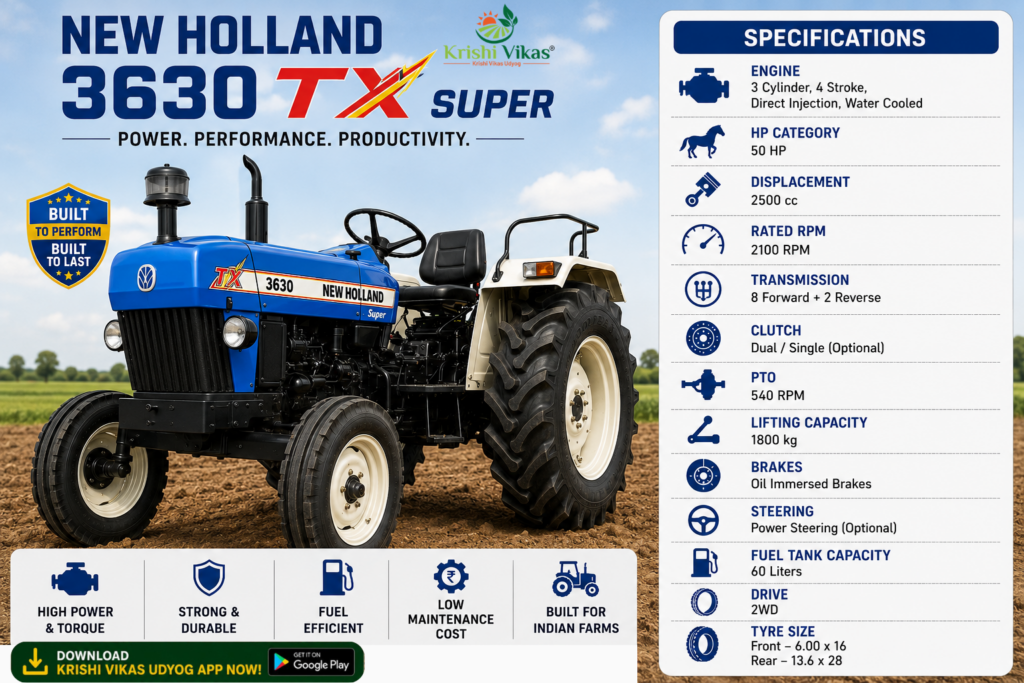
3. Sonalika DI 745 III
The Sonalika DI 745 III is designed around a 3-cylinder engine producing a maximum torque of 210 Nm at a rated speed of 1,900 RPM. Sonalika lists multiple transmission configurations, including 8F+2R, 16F+4R and 12F+3R. The lower rated engine speed can be useful for applications where the tractor can maintain the required output without unnecessarily high engine RPM. However, actual fuel savings will depend heavily on the implement and operating conditions. The tractor also offers a 2,000 kg lifting capacity and optional 4WD, making it suitable for wetland cultivation, rotavation, sowing, haulage and other applications. Best for: Farmers requiring a versatile tractor for field operations, including wetland and haulage applications.
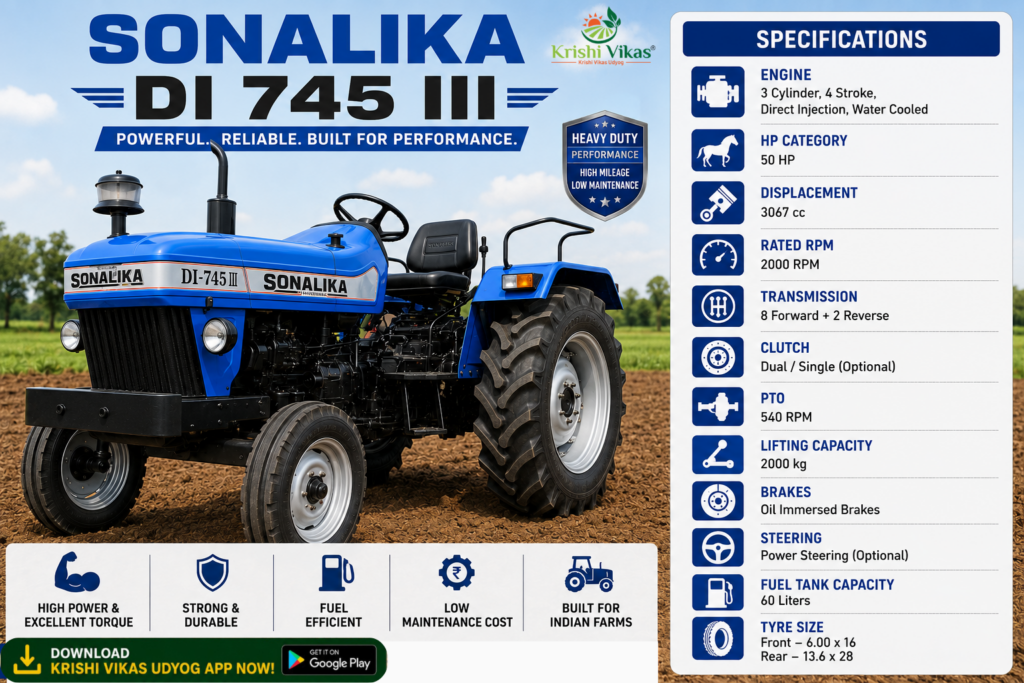
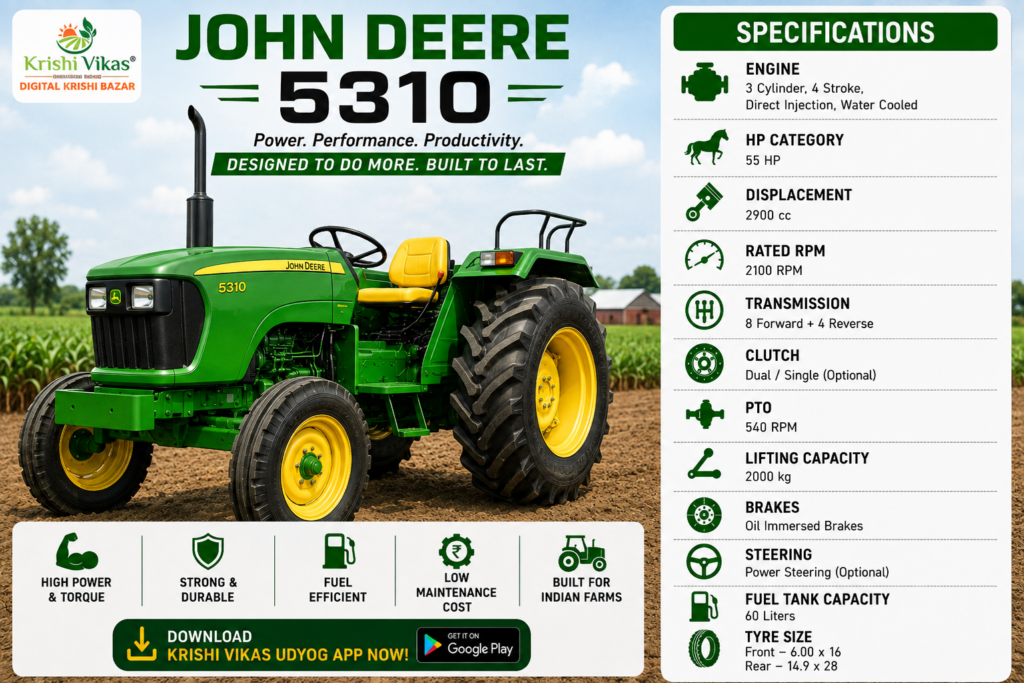
4. John Deere 5310
The John Deere 5310 sits in a higher power category, with a 55 HP engine. John Deere’s current 5E Series specifications list the 5310 with 12F+4R, 12F+12R Power Reverser and creeper-speed transmission options depending on configuration. One particularly relevant feature is its economy PTO setting of 540 RPM at 1,600 engine RPM, compared with the standard PTO setting at 2,100 RPM. This can help reduce engine speed during compatible PTO-driven operations, potentially improving fuel economy when the implement does not require full engine speed. Best for: Farmers who regularly use PTO-operated implements and need a higher-power tractor.
5. Swaraj 855 FE
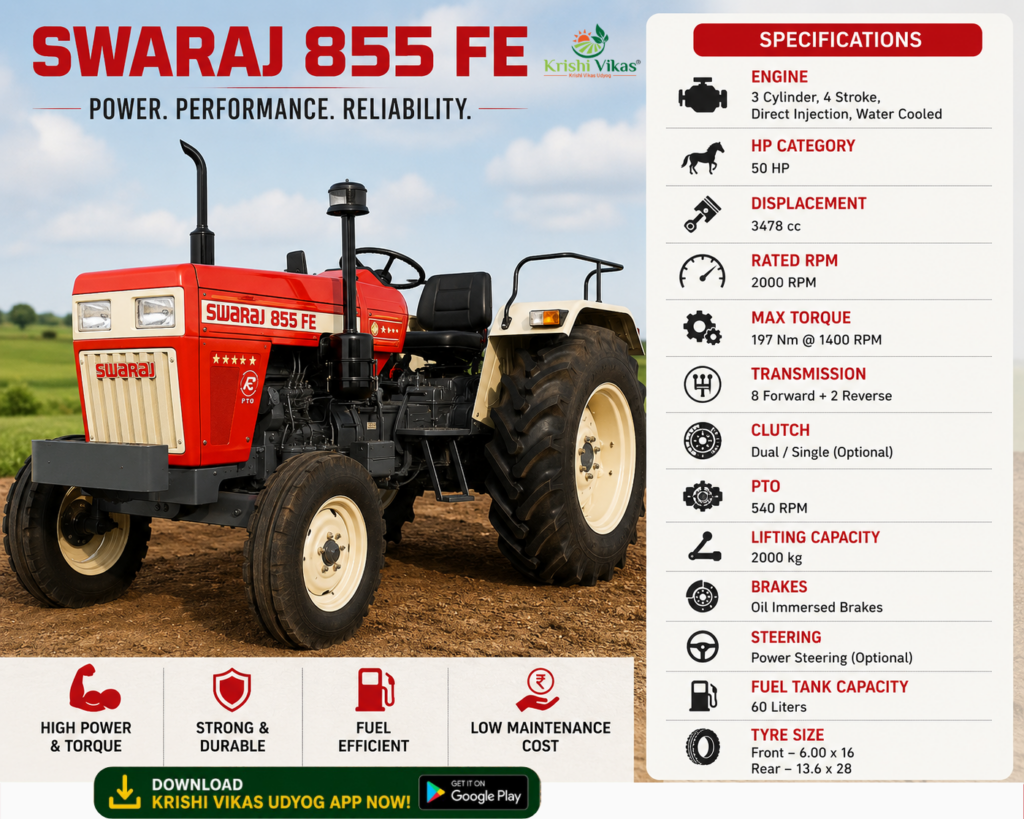
The Swaraj 855 FE is a popular tractor in the approximately 46–50 HP segment and is frequently compared with models such as the Mahindra 575 DI XP Plus and Sonalika DI 745 series. Its 3-cylinder engine and approximately 3.5-litre displacement provide the torque needed for demanding applications. Independent comparison listings place the Swaraj 855 FE in the 46–50 HP category. Best for: Farmers who prioritize strong field performance and want a proven tractor in the 45–50 HP category.
What Makes a Tractor Fuel Efficient?
Fuel efficiency is not determined by engine size alone. Several factors influence how much diesel a tractor consumes.
1. Engine efficiency
An engine that produces adequate torque at the required operating speed can reduce the need to operate continuously at high RPM.
For example, Mahindra’s published SFC figure for the 575 DI XP Plus provides a more technical measure of engine fuel efficiency than a simple “km/litre” claim.
2. Torque characteristics
Higher torque does not automatically mean better fuel economy, but strong torque at useful operating speeds can help a tractor maintain performance under load without excessive RPM increases.
3. Transmission
A suitable transmission allows the operator to select an appropriate gear and engine speed for the job. Modern tractors offer several transmission configurations. John Deere’s 5310, for example, offers multiple transmission choices, including Power Reverser and creeper-speed configurations.
4. PTO operating speed
PTO work can consume considerable fuel when the engine is operated unnecessarily fast. Economy PTO modes, where available, allow certain implements to operate at the required PTO speed with lower engine RPM.
5. Tractor weight and traction
A tractor that is too light for the application may experience wheel slip, while excessive weight can increase rolling resistance. The objective is to select a tractor with enough weight and traction for the implements and soil conditions involved.
How to Improve Tractor Fuel Efficiency
1. Maintain the engine regularly
Dirty air filters, poor-quality lubricants, injector problems and inadequate cooling can negatively affect engine performance.
2. Use the right implement
An implement that is too large for the tractor can keep the engine under excessive load. Conversely, using an undersized implement while operating at unnecessarily high RPM can also waste fuel.
3. Select the correct gear
Use the highest practical gear that allows the tractor to perform the job without excessive engine strain.
4. Avoid unnecessary idling
If the tractor is stationary for extended periods, unnecessary idling increases fuel consumption without adding productivity.
5. Maintain correct tyre pressure
Incorrect tyre pressure can increase rolling resistance and wheel slip. Follow the manufacturer’s recommended tyre-pressure settings for the tractor and application.
6. Reduce wheel slip
Excessive wheel slip wastes engine power. Proper ballast, tyre selection and operating technique can improve traction and fuel use.
How to Compare Tractor Mileage Correctly
Before buying a tractor, farmers should ask dealers for information about:
- Fuel consumption under comparable workloads
- Engine SFC, where available
- Recommended operating RPM
- PTO operating speeds
- Suitable implement sizes
- 2WD versus 4WD fuel implications
- Service intervals
- Maintenance requirements
- Warranty coverage
- Availability of local service and spare parts
It is also useful to compare tractors within the same HP and application category. Comparing a 40–50 HP tractor with a 70 HP tractor solely on litres per hour can produce a misleading conclusion.
Fuel Efficiency vs Productivity
The lowest fuel consumption is not always the lowest operating cost. Suppose Tractor A uses slightly more diesel per hour but completes an acre considerably faster than Tractor B. Tractor A could potentially consume less fuel per acre despite having higher hourly consumption.
Farmers should therefore consider:
Fuel cost per acre = Fuel consumed per acre × Diesel price
Other operating costs such as maintenance, labour, implement compatibility and downtime should also be considered.
How Krishi Vikas Help Famers
Krishi Vikas helps farmers explore tractor options and connect with tractor dealers so they can compare suitable models and obtain more information before making a purchase decision. Choosing a fuel-efficient tractor requires more than comparing mileage claims. Farmers need to match the tractor with their farm size, crops, soil conditions, implements, horsepower requirements and budget. Instead of selecting a tractor only because it has a high mileage claim, farmers can use dealer discussions to understand the model’s specifications, suitable applications, financing options and after-sales support.
Final Verdict
Fuel efficiency is becoming increasingly important as farmers look to control operating costs. Models such as the Mahindra 575 DI XP Plus, New Holland 3630 TX Super, Sonalika DI 745 III, John Deere 5310 and Swaraj 855 FE offer different approaches to balancing fuel consumption, power and productivity.
Among these, the Mahindra 575 DI XP Plus stands out for its manufacturer-published SFC figure of 185 g/hp-hr, while the New Holland 3630 TX Super carries a specific manufacturer claim for best-in-class mileage. John Deere’s 5310 offers an economy PTO mode that can be useful for compatible PTO applications. Ultimately, the most fuel-efficient tractor is the one that completes your required work efficiently at the lowest overall cost per acre. Farmers should compare real-world application requirements rather than relying on a single mileage number.
Frequently Asked Questions
1. Which tractor gives the best mileage in 2026?
There is no universally applicable mileage winner because tractor fuel consumption varies by application. Mahindra publishes a low SFC figure of 185 g/hp-hr for the 575 DI XP Plus is marketed with a best-in-class mileage claim.
2. Is a Higher HP Tractor Always Less Fuel Efficient?
A higher-horsepower tractor can consume more fuel per hour, but that does not necessarily mean it is less efficient. For example, a larger tractor may complete a heavy tillage operation in fewer hours than a smaller tractor. The more useful measure for the farmer is often fuel consumed per acre or per completed task, rather than litres consumed per hour alone.
3. Is 2WD more fuel efficient than 4WD?
Not necessarily in every situation. 2WD can have lower drivetrain losses and may be suitable for many dry-field applications, while 4WD can provide better traction and reduce wheel slip in difficult soil conditions. The actual fuel cost depends on the job.
4. Does higher HP mean higher fuel consumption?
Generally, a larger engine can consume more fuel per hour under comparable operating conditions. However, it can also complete heavy work faster, so fuel consumption per acre may be lower.
5. What is SFC in a tractor?
Specific fuel consumption measures the amount of fuel an engine uses to produce a unit of power over time. It is generally expressed in grams per horsepower-hour or grams per kilowatt-hour.
6. How can farmers reduce tractor diesel consumption?
Regular maintenance, correct tyre pressure, proper gear selection, avoiding excessive engine RPM, reducing wheel slip and using correctly matched implements can all help improve fuel economy.
7. Should mileage be the main factor when buying a tractor?
No. Fuel efficiency should be considered alongside horsepower, torque, hydraulics, PTO performance, transmission, implement compatibility, service support and total operating cost.