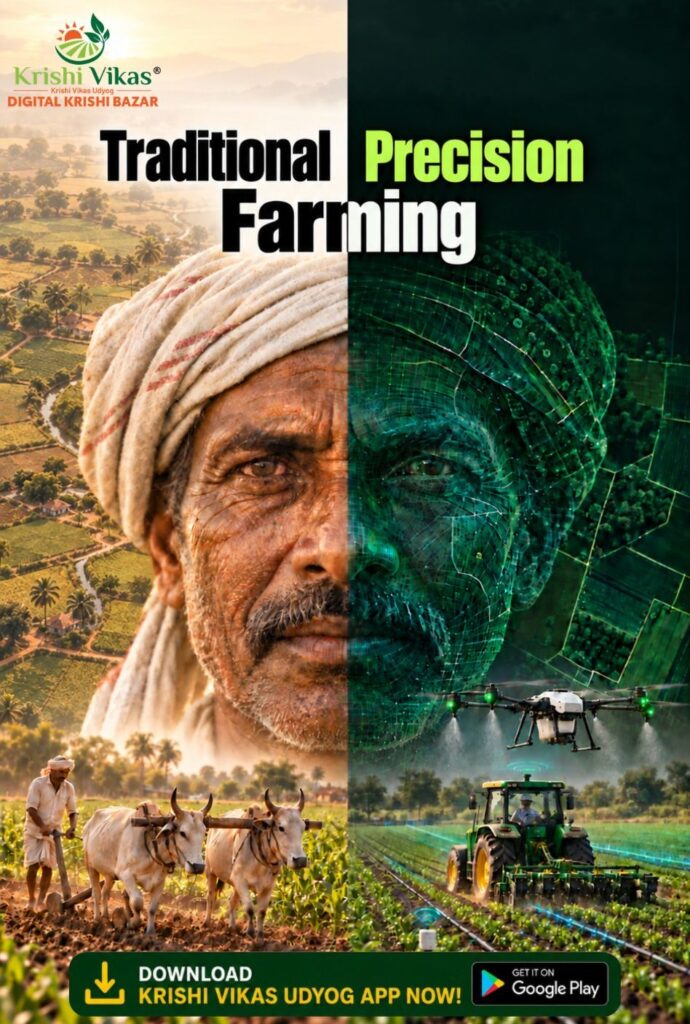
Indian agriculture is moving from broad, input-intensive farming toward data-driven and precision-based farm management. Artificial intelligence (AI), agricultural drones, satellite imagery, sensors, digital crop surveys and connected farm machinery are increasingly being used to improve crop monitoring, input application and decision-making.
The shift is also being supported by government programmes. As of February 2026, more than 8.48 crore Farmer IDs had been generated, while the Digital Crop Survey had covered more than 28.5 crore plots across 604 districts during Kharif 2025. These digital foundations can support more targeted delivery of agricultural services and technology.
For 2026–27, the important question is no longer whether AI and drones will enter Indian agriculture. The bigger question is how quickly farmers can access these technologies at an affordable cost and how effectively they can be integrated into everyday farm operations. Also read the SMAM Scheme: Government Boosts Farm Mechanization for Farmers blog at Krishi Vikas.com.
What Is Precision Farming?
Precision farming means managing different parts of a farm according to their specific requirements rather than treating the entire field in exactly the same way. The objective is simple: apply the right input, at the right place, at the right time and in the right quantity. For Indian farmers, this can be particularly useful where input costs are rising and farms face challenges such as irregular rainfall, pest outbreaks, water stress and labour shortages.
It combines technologies such as:
- GPS and satellite positioning
- Satellite and drone imagery
- Soil and weather sensors
- Artificial intelligence and machine learning
- Digital farm records
- Variable-rate input application
- Automated and connected agricultural machinery
- Mobile-based advisory platforms
How AI Is Changing Indian Agriculture.
1. AI-Based Crop Monitoring
AI systems can analyse satellite images, drone photographs and field-level data to identify differences in crop growth. Instead of waiting until an entire field shows visible damage, image-analysis systems can potentially identify areas showing signs of:
- Nutrient stress
- Water stress
- Pest attack
- Disease
- Poor crop establishment
- Uneven growth
The government has highlighted the use of AI-enabled monitoring involving satellite imagery, drones, sensors and image analytics for earlier detection of pests and crop-related problems. This could make crop scouting more targeted, particularly for larger farms and agricultural service providers.
2. AI-Based Pest and Disease Advisory
The government’s National Pest Surveillance System (NPSS) uses AI and machine learning to support pest monitoring and identification. AI-based systems can analyse field observations and images to help identify potential pest problems and provide advisory information. For farmers, the value lies not simply in identifying a pest but in receiving information early enough to take corrective action.
However, AI recommendations should not automatically replace agronomists or local agricultural officers. Field conditions, crop variety, weather and pesticide labels still need to be considered before treatment.
3. AI-Powered Farmer Advisory
The Ministry of Agriculture and Farmers Welfare has deployed Kisan e-Mitra, an AI-powered virtual assistant designed to answer farmers’ queries, including queries related to PM-KISAN. The broader opportunity is significant. The major challenge will be making these systems accurate, regional-language friendly and useful even for farmers with limited digital literacy.
In the future, AI-based agricultural assistants could help farmers access information about:
- Crop practices
- Weather conditions
- Pest and disease symptoms
- Government schemes
- Subsidies
- Crop insurance
- Market information
- Farm machinery
- Fertilizer and input requirements
The Rise of Agricultural Drones
Drones are among the most visible technologies entering Indian agriculture. Agricultural drones can be equipped with spraying systems, cameras and other sensors. Their applications include:
- Crop spraying
- Field mapping
- Crop monitoring
- Pest and disease surveillance
- Nutrient-stress identification
- Crop damage assessment
- Plant population and growth assessment
Government programmes are already supporting the development of this ecosystem. Under the Sub-Mission on Agricultural Mechanization (SMAM), financial assistance is available for agricultural drones. According to government information, assistance of 40% up to ₹4 lakh is available for eligible purchases, while different assistance provisions apply to institutions and other categories. The government has also supported drones through Custom Hiring Centres (CHCs), allowing farmers who cannot justify individual ownership to access machinery and technology on a rental basis.
Namo Drone Didi: Making Drone Services More Accessible
The Namo Drone Didi initiative is particularly important because it focuses on women Self-Help Groups (SHGs) as drone service providers. The scheme was approved with an outlay of ₹1,261 crore for 2023–24 to 2025–26 and aims to provide 15,000 drones to selected women SHGs for agricultural rental services. The model is important for a practical reason. Instead of every farmer purchasing a costly drone, an SHG or other service provider can own the equipment and provide services to farmers on a rental basis. This is similar to the Custom Hiring Centre model already used for tractors and farm implements.
Why the service model matters
For many small and marginal farmers, the biggest barrier is not awareness but ownership cost. A farmer may need drone spraying only a few times during a crop season. Buying a drone, maintaining it, training an operator and complying with operational requirements may not make economic sense. A rental model can convert drone technology from a capital purchase into a farm service.
Drone Adoption Is Expanding
India’s drone ecosystem has also grown beyond agriculture. As of February 2026, India had more than 38,500 registered drones, nearly 39,890 DGCA-certified remote pilots and 244 approved training organisations, according to government data.
The agricultural ecosystem has also seen significant demonstrations. Between 2023–24 and 2025–26, as of November 30, 2025, ICAR institutions, State Agricultural Universities and Krishi Vigyan Kendras conducted drone demonstrations across more than 41,010 hectares, benefiting more than 4.52 lakh farmers. These numbers indicate that agricultural drones are moving beyond pilot projects toward a broader service ecosystem.
Advantages Of Drone Spraying
1. Faster field coverage
A drone can cover agricultural fields without requiring a tractor or heavy machinery to enter the crop.
This is particularly relevant for crops where:
- Plants are tall
- Fields are waterlogged
- Soil is soft
- Crop rows are difficult to access
- Conventional spraying could damage plants
2. Reduced crop disturbance
Because the drone flies above the crop, it does not require wheels to move through standing crops.
3. Targeted application
Drone spraying can potentially support more precise application when the operator follows the recommended dosage, spray volume and flight parameters.
However, drone spraying should not be treated as automatically more efficient simply because it is aerial. Weather, wind speed, formulation, nozzle type, droplet size, flight height and operator skill can significantly affect results.
Farmers should always follow the pesticide label and applicable regulatory requirements.
Satellite Imagery + Drones + AI: The Bigger Opportunity
The real transformation will not come from a drone working alone. The larger opportunity is the combination of multiple technologies.
For example:
Satellite imagery → identifies an unusual area
↓
AI → analyses the pattern
↓
Drone → captures high-resolution images
↓
Agronomist/AI → identifies possible crop stress
↓
Drone or machinery → applies the required treatment
This creates a technology chain in which each tool performs a different function. Satellite data provides large-area monitoring. Drones provide high-resolution field-level information. AI provides data interpretation. Farm machinery provides physical execution. That combination could become one of the defining characteristics of precision agriculture in India.
Digital Agriculture Mission Creates the Data Layer
The government’s Digital Agriculture Mission is designed to build a digital ecosystem integrating farmer information, land records and crop-related data. The progress is already substantial. By February 2026, more than 7.63 crore Farmer IDs had been generated according to one government update, while another February update reported more than 8.48 crore Farmer IDs by February 4, 2026, reflecting continued expansion of the programme. During Kharif 2025, the Digital Crop Survey covered more than 28.5 crore plots across 604 districts. This type of plot-level information can eventually support better:
- Crop planning
- Input distribution
- Procurement planning
- Disaster assessment
- Credit delivery
- Insurance processes
- Agricultural advisories
Precision Farming Will Not Mean the Same Thing for Every Farmer
One of the biggest misconceptions about precision farming is that every farmer needs expensive sensors, autonomous tractors and drones.
- For a small farmer, precision farming could simply mean: soil testing + weather advisory + mobile-based crop advisory + drone spraying on rent.
- For a medium-sized farmer, it could include: GPS-enabled machinery + satellite monitoring + drone services + digital farm records.
- For large commercial farms, the technology stack could become more advanced: IoT sensors + satellite imagery + AI analytics + automated machinery + variable-rate application + farm management software.
Therefore, precision farming should be viewed as a scalable approach rather than a single technology package.
What About Smart Tractors and Farm Machinery?
The next phase of precision agriculture will increasingly connect digital technology with tractors and implements.
Modern tractors can already incorporate technologies such as:
- GPS
- telematics
- digital instrument panels
- engine monitoring
- remote diagnostics
- automatic guidance
- connected farm-management systems
The future could see more integration between tractors, implements and farm data. For example, a digital farm map could help determine where different levels of seed, fertilizer or crop protection inputs are required. A connected tractor and implement could then execute those instructions more accurately. This is where precision farming moves from information to action.
Precision Irrigation and Water Management
Water management is another area where AI and sensors can become important. Soil-moisture sensors can monitor moisture conditions at different points in a field. Weather data can provide information about:
- Rainfall
- Temperature
- Humidity
- Evapotranspiration
- Heat stress
AI models can then combine this information to support irrigation decisions. For water-stressed regions, this could help farmers avoid unnecessary irrigation while protecting crops from moisture stress. The technology is particularly relevant for crops grown under drip and sprinkler irrigation systems.
AI and Climate-Smart Farming
Climate variability is making farm decision-making more complicated. Farmers increasingly have to deal with:
- Irregular rainfall
- Heat waves
- Dry spells
- Extreme rainfall
- New pest patterns
- Changing sowing windows
AI can help process large amounts of weather and crop data to generate more localized recommendations.
For example, future advisory platforms could combine: weather forecast + soil information + crop stage + historical farm data to provide more specific recommendations for irrigation, spraying or crop management. The government’s broader technology initiatives already identify AI and IoT applications in areas such as precision farming and climate monitoring.
What Farmers Can Expect in 2026–27
1. More drone rental services
Farmers are likely to increasingly access drones through:
- Custom Hiring Centres
- FPOs
- Women SHGs
- Agricultural service providers
- Local entrepreneurs
- Dealer/service networks
2. More AI-based advisories
AI assistants are likely to become more common for crop, scheme and agricultural information.
3. Greater use of satellite data
Satellite-based monitoring can increasingly support crop assessment and field-level decision-making.
4. Better digital farm records
Farmer IDs and digital crop information can improve the ability of government and agricultural service providers to deliver targeted services.
5. Growth of precision spraying
Drone spraying is likely to remain one of the most immediately visible applications because it directly addresses labour availability and crop-access challenges.
6. More technology-enabled farm machinery
Tractors and implements are expected to become increasingly connected through telematics, GPS and digital systems.
Major Benefits for Farmers
If implemented correctly, AI and precision farming technologies can potentially deliver benefits across several areas. The key word is potential. Actual benefits depend on data quality, operator skills, farm conditions, connectivity and correct implementation.
| Technology | Potential Farm Benefit |
| AI crop monitoring | Earlier identification of crop stress |
| Agricultural drones | Faster field scouting and spraying |
| Satellite imagery | Large-scale crop monitoring |
| Soil sensors | Better irrigation decisions |
| Weather analytics | Improved farm planning |
| Digital Crop Survey | Better plot-level crop information |
| GPS-enabled tractors | More accurate field operations |
| AI pest surveillance | Faster pest identification |
| Drone rental services | Access without high ownership cost |
| Digital farm records | Better targeting of agricultural services |
Conclusion
AI, drones and precision farming are moving Indian agriculture toward a more measured, targeted and data-driven model.
Government initiatives such as the Digital Agriculture Mission, SMAM, Namo Drone Didi, Digital Crop Survey and AI-enabled agricultural platforms are helping create the infrastructure for this transition.
For 2026–27, the most realistic expectation is not that every Indian farm will become fully automated. Instead, farmers are likely to see more technology available as a service—from drone spraying and digital crop monitoring to AI-based advisories and precision machinery.
For India’s predominantly small and medium-sized farming sector, that service-based approach could be more important than technology ownership.
The future of Indian precision farming will therefore depend not only on better AI and smarter drones, but on making those technologies affordable, accessible, locally relevant and easy for farmers to use.
Krishi Vikas is a Digital Krishi Bazar and we offer agricultural services like Buy/Sell/Rent tractors, harvesters, goods vehicles & agri-equipment. Please contact us for more information.
Subscribe to our Youtube Channel – https://www.youtube.com/@JoinKrishiVikas
Follow us for Latest Tractor Industry Updates!
LinkedIn – https://www.linkedin.com/company/joinkrishivikas/
Facebook – https://www.facebook.com/joinkrishivikas
Instagram – https://www.instagram.com/joinkrishivikas/
Download the Krishi Vikas App now!
Play Store – https://play.google.com/store/apps/details?id=com.krishivikas.android&pcampaignid=web_share
App Store – https://apps.apple.com/in/app/krishi-vikas-udyog-kisan-app/id6449253442