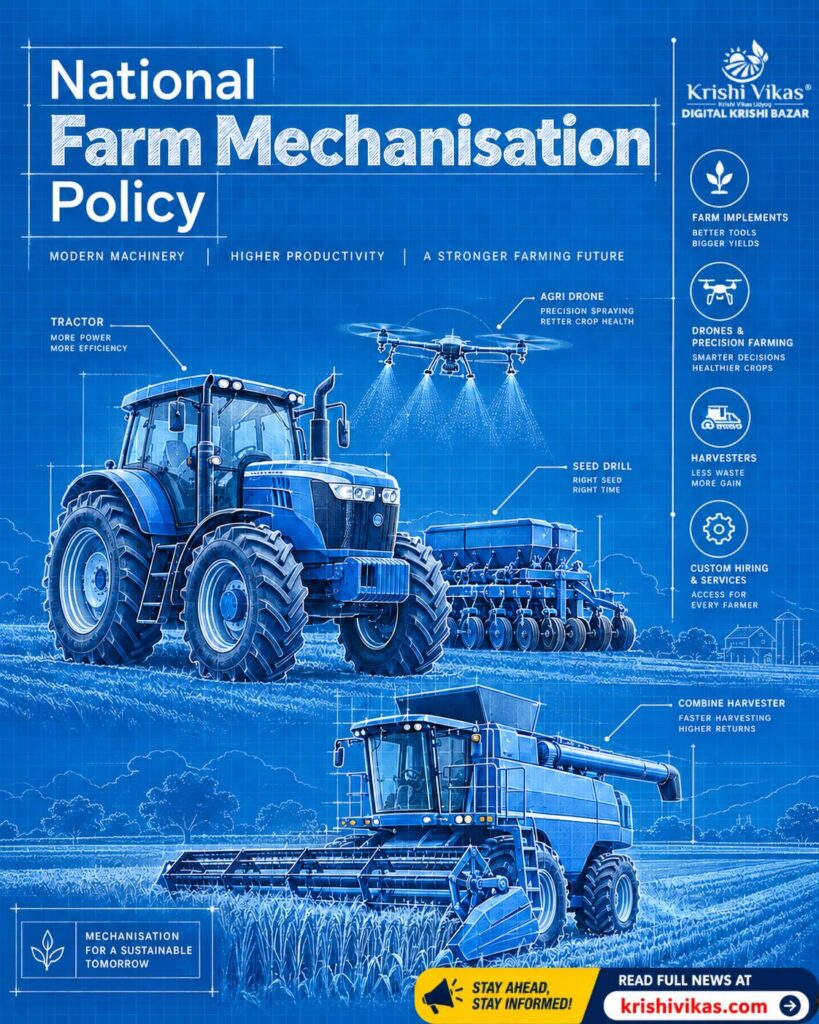
The Rabi 2026–27 season is approaching, and timely field preparation and sowing will be important for farmers growing wheat, mustard, gram, barley, peas and other winter crops. The right farm machinery can help complete operations faster, reduce labour dependence and improve farm efficiency. But machinery selection should be based on crop, farm size, soil, available tractor power and actual usage rather than simply choosing a bigger machine. For Rabi farming, the machinery requirement can range from basic implements such as cultivators and seed drills to specialised equipment such as zero-till drills, residue-management machines and laser land levellers. Also read the How to Select Farm Implements Based on Crop and Acreage blog at Krishi Vikas.com.
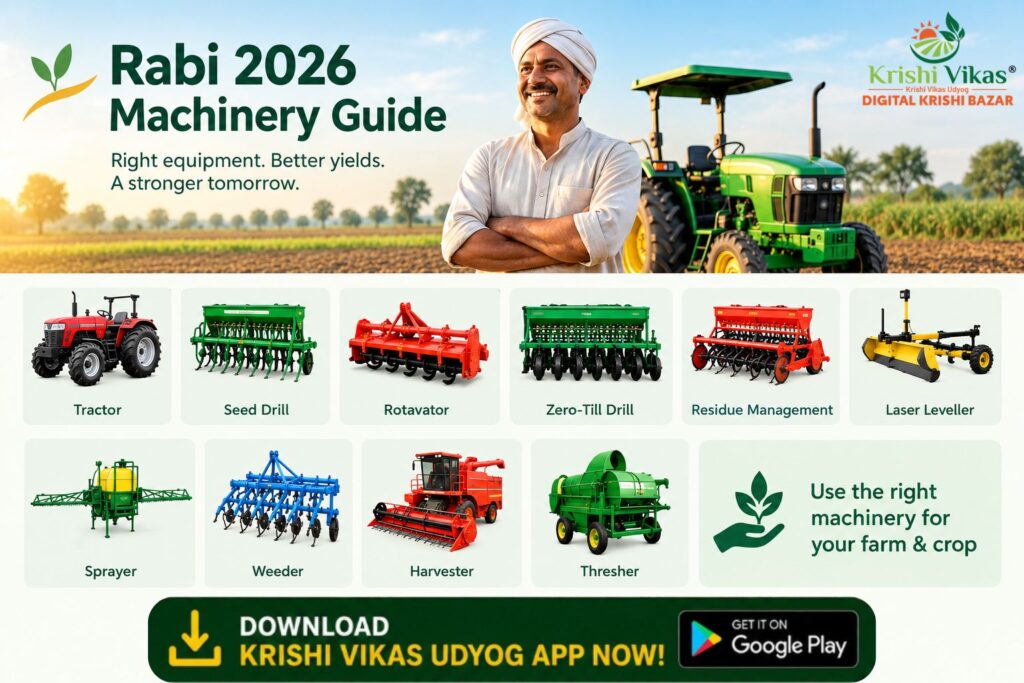
Machinery Checklist
| Farm Operation | Machinery / Implement | Main Purpose |
| Field preparation | Cultivator | Loosens and prepares soil |
| Primary tillage | Disc / mouldboard plough | Opens and turns soil |
| Seedbed preparation | Rotavator / harrow | Prepares soil for sowing |
| Land levelling | Laser land leveller | Creates a more uniform field |
| Sowing | Seed-cum-fertilizer drill | Places seed and fertilizer together |
| Direct sowing | Zero-till drill | Sows with minimal soil disturbance |
| Residue management | Happy Seeder / Super Seeder / RDD | Manages crop residue and supports sowing |
| Crop protection | Tractor-mounted / boom sprayer | Covers larger areas efficiently |
| Weed management | Mechanical weeder | Controls weeds between rows |
| Harvesting | Reaper / combine harvester | Speeds up harvesting |
| Post-harvest | Thresher / cleaner | Separates and cleans grain |
1. Tractor: The Core of Rabi Mechanisation
The tractor remains the main power source for several farm operations, from tillage and sowing to spraying and residue management. However, horsepower alone should not determine the purchase. Farm size, soil condition, cropping pattern, implement requirements, PTO power, hydraulic capacity, 2WD or 4WD requirement and annual usage all matter. A tractor should be matched with the implements it will regularly operate. A well-matched 40–50 HP tractor, for example, can be more practical than a higher-HP tractor that remains underused. Local service, spare-parts availability and dealer support should also be considered before purchase.
2. Seed-Cum-Fertilizer Drill for Rabi Sowing
A seed-cum-fertilizer drill is among the most useful implements for Rabi sowing. It places seed and fertilizer during the same operation and can help farmers cover larger areas within the available sowing window.
When comparing models, pay attention to:
- Working width
- Row spacing
- Seed-metering system
- Fertilizer-metering system
- Tractor power requirement
- Calibration and adjustment
ICAR has documented tractor-operated sowing equipment for crops including wheat and gram. (icar.gov.in)
3. Zero-Till Drill for Wheat After Paddy
For rice-wheat farmers, the time between paddy harvest and wheat sowing can be limited. A zero-till drill allows wheat to be sown with minimal soil disturbance and reduces the need for conventional seedbed preparation.
ICAR has documented tractor-operated zero-till equipment for direct wheat sowing after rice. One documented model operates with a 26 kW tractor, roughly equivalent to 35 HP, under the specified conditions. ICAR also reports savings in sowing time and cost compared with conventional methods for that technology. Its suitability depends on soil moisture, residue level, field condition and tractor compatibility. (icar.gov.in)
4. Residue Management for Rice-Wheat Farms
Paddy residue has become an important part of Rabi machinery planning in rice-wheat regions.
Farmers can choose from technologies such as: Happy Seeder, Super Seeder, Rotary Disc Drill, Surface Seeder, straw chopper-cum-spreader and straw balers.
These machines serve different purposes. Some allow direct sowing through residue, while others incorporate or collect it. The tractor requirement should always be checked for the specific implement being purchased.
ICAR’s documented Rotary Disc Drill, for instance, is designed for direct seeding in crop residue and requires a suitable tractor of at least 45 HP for the documented model. (icar.gov.in)
5. Laser Land Leveller for Better Field Preparation
A laser land leveller can help create a more uniform field surface, which can support more even irrigation and crop establishment. For smaller farms, hiring a laser leveller through a local machinery service or Custom Hiring Centre can be an alternative to buying one.
ICAR identifies scientific land levelling as a resource-conservation practice that can improve irrigation efficiency and support uniform crop establishment. (icar.gov.in)
6. Rotavator: Use According to Soil and Crop Need
The rotavator is widely used for seedbed preparation and residue incorporation, but repeated use is not always beneficial. Its use should therefore be based on soil type, previous crop, residue, moisture and sowing method. Where suitable, reduced-tillage or direct-sowing systems can be considered.
ICAR has cautioned against repeated and indiscriminate rotavator use, citing issues such as soil pulverisation, shallow hardpan formation and deterioration of soil structure. (icar.gov.in)
7. Sprayers for Rabi Crop Protection
Crop protection is another important stage where mechanisation can save time and labour. Larger farms may benefit from tractor-mounted or boom sprayers, while smaller farms may prefer compact or portable equipment. Important specifications include:
tank capacity + boom width + pump capacity + nozzle type + operating pressure.
Proper calibration and application are more important than simply choosing the largest sprayer.
8. Mechanical Weeders for Intercultural Operations
Mechanical weeders can reduce manual labour in crops with suitable row spacing. They can be particularly useful in pulses, oilseeds and some vegetable crops. Selection should consider crop spacing, soil condition, crop stage and power requirement.
9. Harvesting Machinery Should Be Planned Early
Harvesting machinery should be considered at the beginning of the season rather than when the crop is already mature. Depending on the crop and farm size, equipment may include: reapers, reaper binders, combine harvesters, threshers and multi-crop threshers.
For smaller farms, hiring harvesting machinery can often be more practical than owning equipment that is used only for a few days each year.
Rabi Machinery Based on Farm Size
Small farms
A practical setup can include:
tractor + cultivator + seed drill + sprayer
Specialised machines such as laser levellers and combine harvesters can be hired when required.
Medium farms
Farmers may consider:
tractor + cultivator + harrow/rotavator + seed drill + sprayer + weeder
Rice-Wheat farms
Priority can shift towards:
zero-till drill + residue-management equipment + suitable tractor
This combination is particularly relevant where wheat must be sown soon after paddy harvesting.
Buy or Hire Farm Machinery?
Owning machinery provides availability and control, but it also brings additional costs such as EMI, maintenance, storage, repairs and operator expenses. Hiring can be more practical for machines that are needed only for a short seasonal period. This is where Custom Hiring Centres and shared machinery services can help farmers access specialised equipment without making the full investment in ownership. A simple comparison of purchase cost, annual usage, maintenance and local hiring rates can help determine which option makes more sense.
Farm Machinery Subsidy 2026–27
Farm machinery subsidy is another important part of the Rabi machinery-buying decision, but the 40%–50% figure should not be interpreted as a flat subsidy on every machine.
Under the published SMAM framework, assistance is generally 50% for specified beneficiary categories, including small and marginal farmers, SC/ST farmers, women farmers and beneficiaries in the North-Eastern States. The rate for other beneficiaries is generally 40%, subject to applicable conditions. The actual benefit is also subject to machine-wise maximum subsidy ceilings. This means the calculation cannot simply be: machine price × 50% = subsidy
The applicable cost norm, beneficiary category, machine ceiling and state-level implementation all affect the final amount.
Tractor Subsidy: Maximum Permissible Amounts
The detailed SMAM cost norms currently list the following maximum subsidy amounts:
| Tractor Category | 50% Assistance Category | 40% Assistance Category |
| 2WD, up to 20 PTO HP | Up to ₹2.00 lakh | Up to ₹1.60 lakh |
| 4WD, up to 20 PTO HP | Up to ₹2.45 lakh | Up to ₹1.96 lakh |
| 2WD, above 20 to 40 PTO HP | Up to ₹3.00 lakh | Up to ₹2.40 lakh |
| 4WD, above 20 to 40 PTO HP | Up to ₹3.60 lakh | Up to ₹2.88 lakh |
| 2WD, above 40 to 50 PTO HP | Up to ₹4.50 lakh | Up to ₹3.60 lakh |
| 4WD, above 40 to 50 PTO HP | Up to ₹5.45 lakh | Up to ₹4.36 lakh |
| 2WD, above 50 PTO HP | Up to ₹6.00 lakh | Up to ₹4.80 lakh |
| 4WD, above 50 PTO HP | Up to ₹6.50 lakh | Up to ₹5.20 lakh |
These are maximum permissible amounts under the published cost norms, not guaranteed payments for every applicant. (agrimachinery.nic.in)
Example: 45–50 HP Tractor
For a farmer in the 50% assistance category purchasing a 2WD tractor above 40 to 50 PTO HP, the published maximum subsidy is ₹4.50 lakh. For the 40% assistance category, the corresponding maximum is ₹3.60 lakh. The applicable benefit can be lower depending on the admissible cost and other scheme conditions. The same approach applies to implements, where the subsidy rate and maximum amount can vary by machine.
Support for Custom Hiring Centres and Farm Machinery Banks
Government support also covers shared machinery models.
Under the current framework:
- Custom Hiring Centres: up to 40% assistance on project cost, for projects up to ₹250 lakh.
- Farm Machinery Banks: up to 80% assistance, for projects up to ₹30 lakh, with enhanced provisions for specified regions and categories.
These are project-level provisions and should not be confused with individual farmer tractor subsidies.
Check State Rules Before Purchase
SMAM is implemented through state governments, so the eligible machines, application periods, approved costs, beneficiary categories and selection process can differ between states. The official Agriculture Mechanization DBT portal and the respective state agriculture department should be checked for the latest 2026–27 rules and application windows.
For instance, the portal currently lists a second SMAM 2026–27 application/lottery window in Kerala from 22 September to 15 October 2026. (agrimachinery.nic.in) Farmers should verify eligibility and subsidy availability before purchasing the machine, rather than assuming that a subsidy will automatically be available after purchase.
Krishi Vikas Take
Rabi mechanisation is about choosing the right equipment, not simply buying more equipment. A wheat farmer may benefit most from a well-matched seed drill or zero-till drill. A rice-wheat farmer may need to prioritise residue management and timely sowing. For smaller farms, hiring specialised machines can be more practical than owning them.
Subsidy can also reduce the cost of mechanisation, but farmers should look beyond the headline 40% or 50% assistance and check the applicable machine-wise ceiling, beneficiary category and state rules. The best machinery decision is one that fits the farm’s crop, acreage, tractor, workload and budget.
Krishi Vikas helps farmers explore tractors, implements and agricultural machinery, compare dealers and evaluate options based on their farm requirements.
FAQs
1. What machinery is commonly used for Rabi farming?
Common equipment includes tractors, cultivators, seed-cum-fertilizer drills, sprayers and weeders. Rice-wheat farmers may also need zero-till or residue-management equipment.
2. Which machinery is useful for wheat after paddy?
Zero-till drills and residue-management machines such as Happy Seeder and Rotary Disc Drill can be suitable depending on field and residue conditions.
3. Is a 40 HP tractor enough for Rabi operations?
A 40 HP tractor can perform many Rabi operations, but specialised implements may require higher power. The tractor should always be matched to the implement requirement.
4. Should farmers buy or hire farm machinery?
The decision depends on annual usage and local hiring rates. Seasonal or expensive machines that are used for only a few days can often be hired more economically.
5. Is the SMAM subsidy a flat 40% or 50%?
No. The assistance rate depends on the beneficiary category and is subject to machine-wise maximum subsidy ceilings and state-level rules.
6. What is the maximum subsidy on a 45–50 HP tractor?
Under the published SMAM cost norms, the maximum permissible amount is ₹4.50 lakh for a 2WD tractor and ₹5.45 lakh for a 4WD tractor for the 50% assistance category. For the 40% category, the corresponding ceilings are ₹3.60 lakh and ₹4.36 lakh.
7. Where can farmers check the latest subsidy information?
Farmers should refer to the official Agriculture Mechanization DBT portal and their state agriculture department for current 2026–27 eligibility, machinery lists, subsidy limits and application schedules.
Krishi Vikas is a Digital Krishi Bazar and we offer agricultural services like Buy/Sell/Rent tractors, harvesters, goods vehicles & agri-equipment. Please contact us for more information.
Subscribe to our Youtube Channel – https://www.youtube.com/@JoinKrishiVikas
Follow us for Latest Tractor Industry Updates!
LinkedIn – https://www.linkedin.com/company/joinkrishivikas/
Facebook – https://www.facebook.com/joinkrishivikas
Instagram – https://www.instagram.com/joinkrishivikas/
Download the Krishi Vikas App now!
Play Store – https://play.google.com/store/apps/details?id=com.krishivikas.android&pcampaignid=web_share
App Store – https://apps.apple.com/in/app/krishi-vikas-udyog-kisan-app/id6449253442