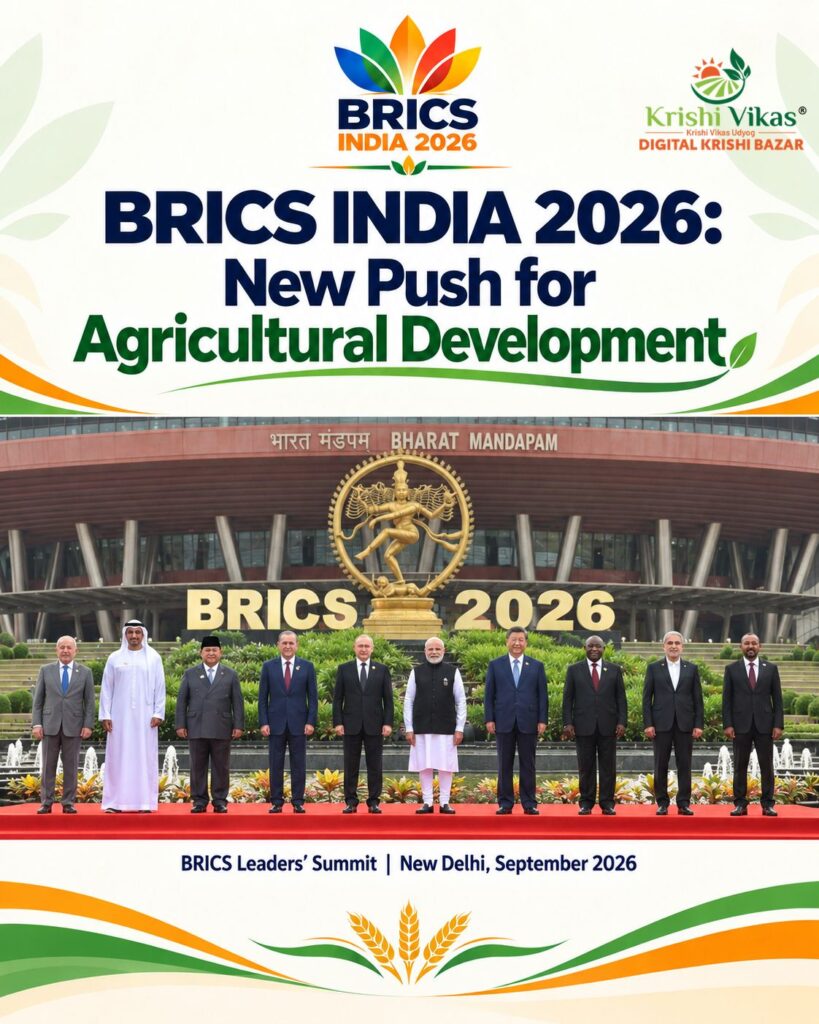
India’s BRICS Presidency in 2026 has given agriculture a much larger role in the grouping’s economic and development agenda. The focus is no longer limited to food production. The new agenda for BRICS India 2026 covers food security, climate-resilient farming, digital agriculture, agricultural trade, mechanisation, farmer rights, research and agri-tech innovation.
The most important agriculture outcome came from the 16th BRICS Agriculture Ministers’ Meeting held in Indore on 12–13 June 2026, where participating countries unanimously adopted the Indore Declaration. The declaration sets out a farmer-centric framework for cooperation and identifies four priorities: food security and livelihoods; agricultural trade; regenerative and climate-resilient agriculture; and innovation and investment for future-ready food systems.
The agenda gained further momentum in September 2026, with India calling for deeper intra-BRICS trade, easier market access, stronger supply chains and greater cooperation in agriculture and agri-tech startups.
Also read the SMAM Scheme: Government Boosts Farm Mechanization for Farmers blog at Krishi Vikas.com.
Why BRICS Agriculture Matters for India
Agriculture has become an important part of BRICS cooperation because the grouping brings together major producers, consumers and exporters of food and agricultural commodities.
At the June 2026 agriculture meeting, India highlighted that its agriculture sector had recorded around 4.5% average annual growth over the previous decade, with food production reaching about 376 million tonnes. The government also highlighted the growing role of technology, natural farming, women and youth in agricultural transformation.
For India, the BRICS platform offers an opportunity to move from domestic agricultural initiatives toward international cooperation in technology, research, inputs, trade and climate resilience.
Four Priorities Define the BRICS Agriculture Roadmap
1. Food Security, Nutrition and Rural Livelihoods
The first priority is strengthening food security while improving rural livelihoods.
The Indore Declaration recognises that agriculture is facing interconnected challenges, including climate risks, water and land degradation, biodiversity loss, low productivity, market volatility and supply-chain disruptions. BRICS countries agreed that cooperation and experience-sharing are essential to address these problems. The farmer remains at the centre of this approach, with particular attention to smallholders, women farmers and rural youth. This is important for India because agricultural growth cannot be considered successful only through higher production. Farm incomes, access to technology, risk management and participation in value chains increasingly matter just as much.
2. Agricultural Trade and Market Access
BRICS countries agreed to strengthen cooperation on agricultural trade, food safety, standards and digital certification. Discussions around a BRICS Grain Exchange are also part of the declaration, with members continuing work on its possible operating framework. For Indian agriculture, better trade cooperation could support opportunities in areas such as rice, spices, processed food, horticulture, dairy and fisheries. However, increased trade will depend on more than demand. Exporters will need to meet quality, traceability, food-safety and phytosanitary requirements in destination markets. That makes the trade agenda closely connected to improvements in farm infrastructure, processing, storage and certification.
3. Climate-Resilient and Regenerative Agriculture
Climate change is one of the clearest themes running through the Indore Declaration. BRICS members endorsed greater cooperation on regenerative agriculture, agroecology, natural farming, organic farming, soil health and sustainable land management. The goal is to improve resilience while protecting natural resources. One of the major announcements was a BRICS Network of Centres of Excellence on Agroecology and Regenerative Agriculture. India’s ICAR–Indian Institute of Farming System Research, Modipuram, is set to coordinate India’s Centre of Excellence on Natural Farming. The proposed network will facilitate research, demonstration projects, knowledge sharing and capacity building among participating countries. For farmers, the long-term importance is clear: climate resilience has to become part of everyday farming decisions involving soil, water, seeds, inputs and crop choices.
4. Digital Agriculture Moves to the BRICS Agenda
The Indore Declaration proposes a BRICS Network on Digital Agriculture, with cooperation around technologies such as artificial intelligence, geospatial intelligence, satellite-based monitoring, IoT and digital agricultural platforms. India’s IIT Delhi is expected to initially coordinate the network. The important point is that BRICS is looking beyond technology development toward practical deployment.
For Indian farmers, digital agriculture could support:
- Crop monitoring: satellite and geospatial data can improve field-level visibility.
- AI-based advisories: farmers can receive more targeted information for crop and resource management.
- Resource efficiency: digital tools can help improve decisions around water, fertiliser and crop protection.
- Market connectivity: digital platforms can strengthen access to information and agricultural value chains.
India’s own push toward digital farmer services provides a strong domestic base for this cooperation.
New BRICS Platform for Farmers’ Seed Rights
The declaration also proposes a Global Forum on Farmers’ Rights in Seed Systems. The platform is intended to promote information exchange and documentation of traditional knowledge and seed systems while considering both farmers’ rights and plant breeders’ rights. India is expected to coordinate the forum through the Protection of Plant Varieties and Farmers’ Rights Authority. This could become increasingly relevant as farmers and policymakers look for crop varieties that are better adapted to changing climatic conditions. The seed agenda also adds another dimension to food security: preserving genetic diversity while ensuring farmers have access to suitable planting material.
BRICS AgriN: Focus on Agricultural Inputs
Another new cooperation mechanism is BRICS AgriN — the Agro-Inputs, Genetic Resources and Information Network. The proposed network covers information exchange related to seeds, genetic resources, fertilisers, bio-inputs, agrochemicals and other agricultural inputs. The declaration also encourages cooperation across input supply chains.
For India, this has practical significance because farm productivity depends heavily on timely access to quality inputs. Input security also matters at a broader level. Disruptions in fertiliser, seed or other agricultural supply chains can affect production costs and farm planning across entire regions.
From Agricultural Research to “Knowledge to Action”
The BRICS Agricultural Research Platform (BARP) is being strengthened as a “Knowledge-to-Action” hub, with an emphasis on connecting research institutions, universities, startups, extension agencies and private-sector players. The BRICS agricultural agenda also attempts to address an old problem: the gap between research and field-level adoption.
India already has a large network of ICAR institutions, agricultural universities, startups and technology companies. Stronger international partnerships could help Indian innovations gain wider testing and markets, while giving Indian farmers access to technologies and practices developed in other BRICS countries.
Mechanisation for Small Farmers
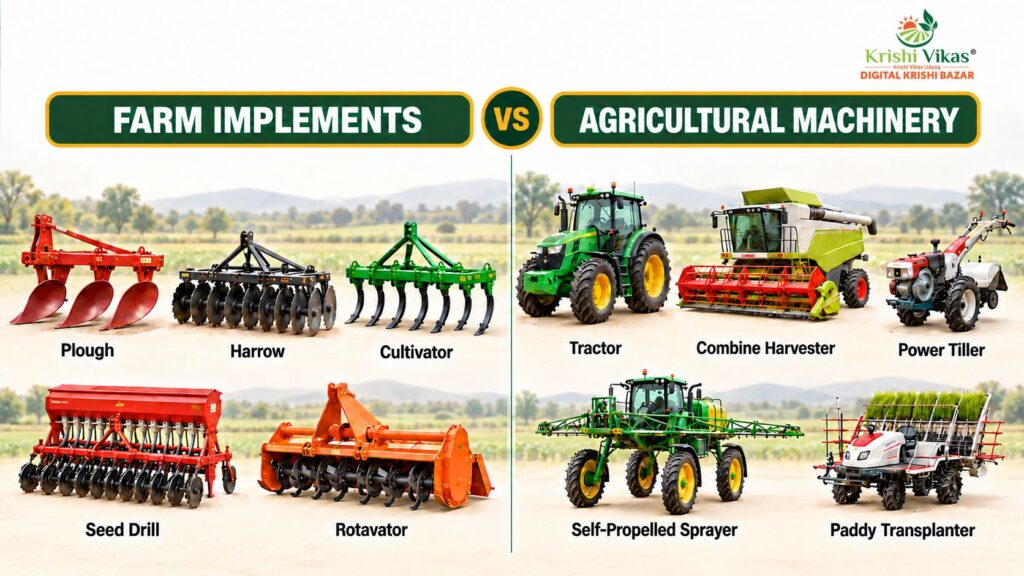
BRICS countries support inclusive and affordable agricultural mechanisation, especially technologies suitable for small and family farmers. The declaration encourages partnerships and investment in machinery designed around smallholder requirements.
This direction is particularly relevant to India. For many small farmers, owning every piece of farm machinery is economically unrealistic. Access models such as Custom Hiring Centres, machinery services and shared equipment can therefore become more important than individual ownership. The future of agricultural mechanisation may increasingly be about access to machinery when needed, rather than simply increasing machine ownership.
Agriculture, Livestock and Fisheries Are Being Connected
The BRICS roadmap does not treat crop farming as the entire agricultural economy. The Indore Declaration also calls for stronger cooperation in livestock, dairy, fisheries and aquaculture, covering areas such as animal health, feed, genetic improvement, technology, finance and climate resilience. The broader approach matters because rural income in India increasingly comes from diversified activities rather than crops alone. A more integrated policy framework can help farmers spread risk across crop production, dairy, livestock and fisheries.
Reducing Post-Harvest Losses
BRICS countries have emphasised cooperation in storage, processing, cold chains, digital traceability and food-loss reduction. Better post-harvest infrastructure can increase food availability while helping farmers retain more value from what they produce.
This is particularly important for perishable commodities such as fruits, vegetables, dairy and fish. For India, investments in rural storage, logistics, food processing and cold-chain infrastructure could therefore be as important as increasing field productivity.
September 2026: Agriculture Moves Closer to the Trade and Startup Agenda
The agriculture discussion did not end with the Indore meeting. At the BRICS Business Forum in New Delhi on 11 September 2026, Commerce and Industry Minister Piyush Goyal called for deeper and more balanced intra-BRICS trade, simpler regulatory procedures and stronger cooperation in agriculture, startups and emerging technologies.
The push is especially relevant to agri-tech. India is increasingly trying to connect farmers not only with traditional agricultural institutions but also with startups working in AI, drones, digital advisory, farm mechanisation, data and supply chains.
The September BRICS discussions reinforce the idea that agriculture can become both a food-security sector and a technology-driven business ecosystem.
What BRICS 2026 Means for Indian Farmers
The BRICS decisions do not create a new uniform subsidy or direct income-support programme for Indian farmers. Instead, they create a framework for cooperation among countries.
The potential impact for Indian agriculture is therefore likely to come gradually through five channels:
- Technology: greater access to AI, satellite, geospatial and digital farming solutions.
- Climate resilience: wider research and adoption of regenerative and sustainable farming practices.
- Mechanisation: more affordable and shared access to farm machinery.
- Trade: improved agricultural market access, standards and supply-chain cooperation.
- Innovation: stronger connections among research institutions, startups, investors and farmers.
The Bigger Opportunity for India
India’s BRICS Presidency comes at a time when agriculture is undergoing a fundamental transition. The next stage of growth will not be defined only by tractors, fertiliser or higher yields. It will increasingly depend on how effectively India combines technology, machinery, climate-smart practices, quality inputs, research, storage and market access.
The BRICS framework provides an international platform to accelerate that transition. The opportunity is particularly significant for India because the country can contribute its strengths in digital public infrastructure, agricultural research, natural farming, mechanisation, agri-tech startups and large-scale food production, while also learning from other major agricultural economies.
Krishi Vikas Take
BRICS India 2026 is pushing agriculture from a production-first model toward a more connected, technology-driven and climate-resilient ecosystem. The Indore Declaration is important because it connects issues that are often discussed separately—food security, digital agriculture, farmer rights, mechanisation, climate resilience, agricultural trade and research.
But the real test will be implementation. For farmers, international declarations matter only when they result in better farm machinery, affordable technology, reliable inputs, stronger storage, easier market access and higher farm returns.
India now has the opportunity to turn BRICS cooperation from a diplomatic framework into practical agricultural outcomes—from research labs to farms, and from local innovation to global markets.
Krishi Vikas is a Digital Krishi Bazar and we offer agricultural services like Buy/Sell/Rent tractors, harvesters, goods vehicles & agri-equipment. Please contact us for more information.
Subscribe to our Youtube Channel – https://www.youtube.com/@JoinKrishiVikas
Follow us for Latest Tractor Industry Updates!
LinkedIn – https://www.linkedin.com/company/joinkrishivikas/
Facebook – https://www.facebook.com/joinkrishivikas
Instagram – https://www.instagram.com/joinkrishivikas/
Download the Krishi Vikas App now!
Play Store – https://play.google.com/store/apps/details?id=com.krishivikas.android&pcampaignid=web_share
App Store – https://apps.apple.com/in/app/krishi-vikas-udyog-kisan-app/id6449253442