Tractors are at the centre of modern farm mechanization, but the power source is changing. Diesel tractors remain the dominant choice for demanding agricultural operations, while electric tractors are emerging as an alternative for farmers looking for lower operating emissions, quieter operation and potentially lower energy costs.
The choice between an electric and diesel tractor, however, is not simply about fuel versus electricity. Farm size, daily operating hours, workload, charging infrastructure, tractor power, battery capacity, terrain and purchase price all matter.
India’s farm mechanization ecosystem is already moving toward greater use of mechanical and electric power. ICAR notes that farm power availability increased from 0.36 kW/ha in 1975–76 to 3.04 kW/ha in 2021–22, while electric motors have also become an increasingly important source of farm power.
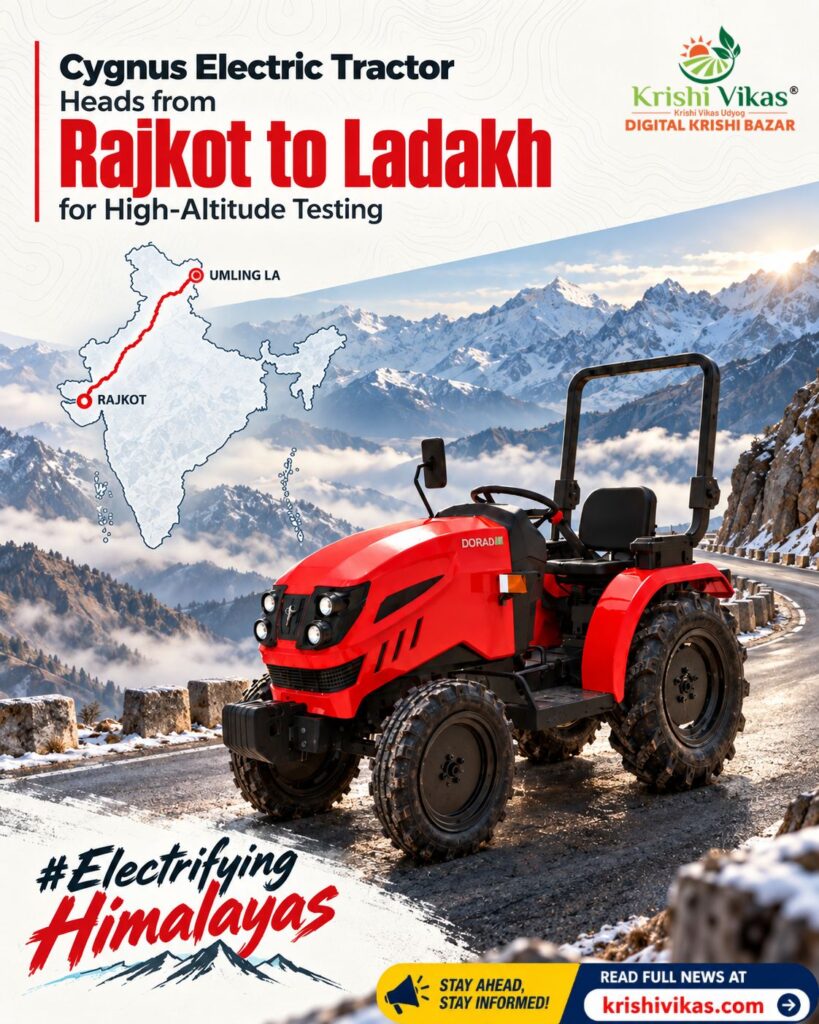
Also read the Cygnus Electric Tractor Heads from Rajkot to Ladakh for High-Altitude Testing blog at Krishi Vikas.com.
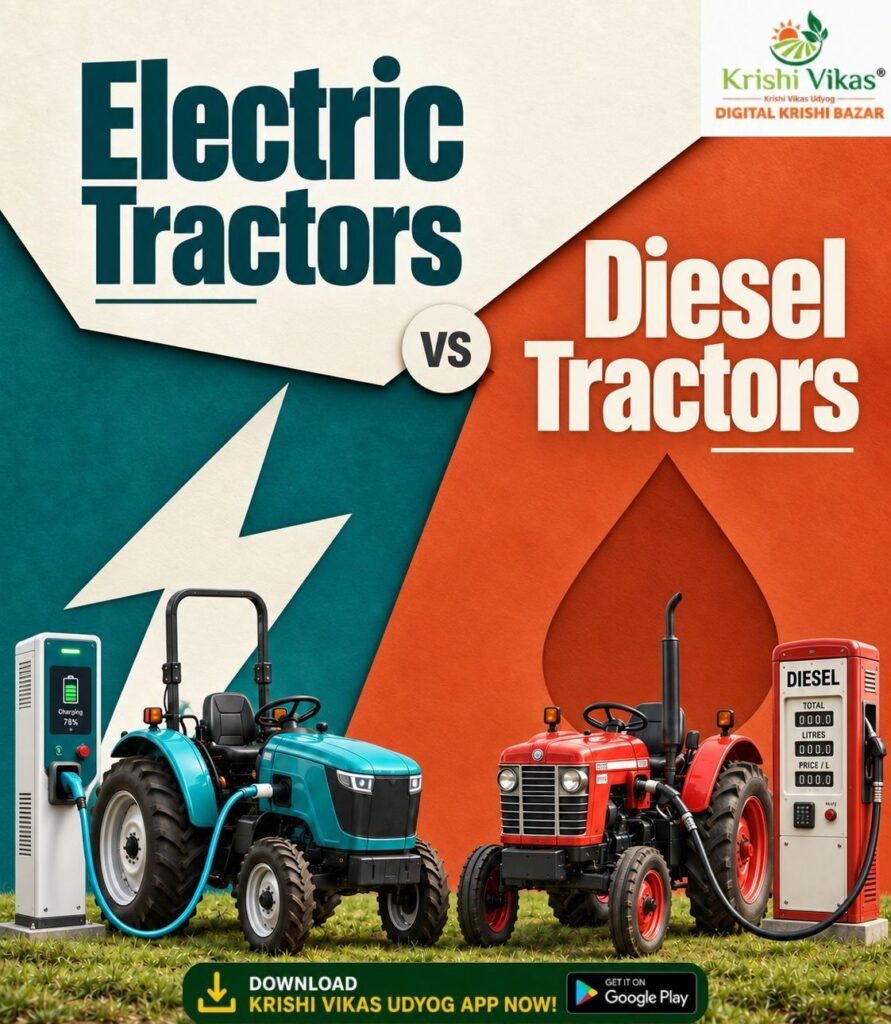
Electric vs Diesel Tractors: Quick Comparison
| Factor | Electric Tractor | Diesel Tractor |
| Power source | Battery-powered electric motor | Diesel engine |
| Fuel/energy cost | Electricity | Diesel |
| Local emissions | Zero tailpipe emissions | Exhaust emissions |
| Noise | Very low | Higher |
| Torque delivery | Instant motor torque | Strong torque, especially at higher loads |
| Refuelling/recharging | Requires charging time | Fast diesel refuelling |
| Long working hours | Limited by battery capacity and charging | Better suited to extended operation |
| Maintenance | Fewer engine-related components | More engine and drivetrain maintenance |
| Heavy-duty operations | Depends on model and battery | Well established |
| Initial cost | Can be relatively high | Wide range of established options |
| Infrastructure | Charging point required | Diesel widely available |
| Best suited for | Shorter, repetitive and lighter-duty work | Heavy and long-duration farm operations |
1. What Is an Electric Tractor?
An electric tractor uses electric motors powered by a rechargeable battery pack instead of a conventional internal-combustion diesel engine. The battery stores electrical energy, which is converted into mechanical power through an electric drivetrain. Depending on the tractor design, electricity can power the traction motor as well as systems such as hydraulics and the PTO.
The basic operating cycle is:
Electricity → Battery → Motor → Transmission/Drive → Wheels + PTO/Implement
Electric tractors are particularly interesting for applications where tractors operate for shorter periods and can return to a charging point between jobs.
2. What Is a Diesel Tractor?
A diesel tractor uses an internal-combustion diesel engine to generate mechanical power. Diesel fuel is burned inside the engine, producing power that is transmitted through the drivetrain to the wheels and PTO.
The basic power flow is:
Diesel → Engine → Transmission → Wheels + PTO/Implement
Diesel tractors have been developed over decades and are available across a very wide range of horsepower categories. This makes them suitable for everything from orchard and intercultural operations to heavy tillage, haulage and large-scale farming.
3. Purchase Cost: Electric vs Diesel
The upfront purchase price is one of the biggest considerations for farmers. Electric tractors require a battery pack, electric motor, power electronics and charging system. Batteries are a significant part of an electric tractor’s cost.
Diesel tractors, on the other hand, use mature and widely established engine technology and benefit from a large manufacturing and service ecosystem. However, purchase price alone does not determine the economic value of a tractor.
Farmers should compare:
- Purchase price
- Financing/EMI
- Energy cost
- Maintenance cost
- Battery warranty
- Expected battery replacement cost
- Annual operating hours
- Resale value
- Subsidy or financial assistance, where applicable
The government’s agricultural mechanization platform provides machinery assistance and subsidy information, but eligibility and applicable assistance depend on the scheme, state, farmer category and specific machinery.
4. Running Cost: Where Electric Tractors Can Have an Advantage
Electric tractors can have a major advantage in energy efficiency and operating cost, depending on electricity prices and the tractor’s workload. An electric motor converts electrical energy into mechanical power without the combustion process used in a diesel engine.
Diesel tractors, meanwhile, require continuous diesel consumption during operation. For farmers with predictable daily workloads and access to affordable charging, electricity can potentially reduce the cost of routine operation.
But there is an important calculation
Farmers should compare:
Cost per hour = Energy/fuel consumed per hour × Energy/fuel price
For an electric tractor:
Electricity cost = kWh consumed × electricity tariff
For a diesel tractor:
Diesel cost = litres consumed × diesel price
Actual consumption varies considerably according to:
- Tractor horsepower
- Implement used
- Soil condition
- Load
- Speed
- Terrain
- Operator behaviour
- Working hours
5. Maintenance: Electric Tractors Have Fewer Engine Components
One of the strongest advantages of electric propulsion is the simpler powertrain. A conventional diesel engine contains many components that require maintenance, including:
- Engine oil
- Oil filters
- Fuel filters
- Injectors
- Belts
- Cooling system
- Exhaust system
- Lubrication system
- Numerous moving engine components
An electric tractor eliminates many of these engine-specific components. This can reduce certain routine maintenance requirements. However, electric tractors are not maintenance-free. Battery health is particularly important because the battery is one of the most expensive components of an electric tractor.
Farmers still need to consider:
- Battery condition
- Cooling systems
- Electrical connections
- Motor and controller systems
- Hydraulic systems
- Tyres
- Brakes
- Transmission components, depending on design
- Software/electronic diagnostics
6. Battery Life Is a Key Consideration
For electric tractors, battery performance is as important as engine performance is for diesel tractors. Battery life depends on factors such as:
- Battery chemistry
- Charging pattern
- Operating temperature
- Depth of discharge
- Charging speed
- Working load
- Battery management system
Farmers should therefore ask manufacturers about:
Battery warranty + expected cycle life + replacement cost + charging time.
A lower purchase price may not necessarily mean lower lifetime ownership cost if battery replacement is expensive or charging infrastructure is inadequate.
7. Charging vs Diesel Refuelling
This is one area where diesel tractors currently have a practical advantage. A diesel tractor can generally be refuelled quickly and returned to work. An electric tractor needs to spend time connected to a charger. For a farmer working only a few hours per day, overnight charging may be sufficient. But for operations requiring long continuous working hours, charging downtime can become a serious constraint.
Charging time depends on:
- Battery capacity
- Charger capacity
- State of charge
- Charging technology
- Electrical infrastructure
Example
A farmer who uses a tractor for 3–5 hours/day may find scheduled overnight charging practical. A farmer who needs: 8–12 hours of continuous heavy operation may find a diesel tractor more convenient unless the electric tractor has sufficient battery capacity and fast-charging or battery-swapping support.
8. Performance and Torque
Electric motors have an important technical advantage: high torque can be delivered from very low speed. This can provide smooth acceleration and responsive operation. Diesel engines, however, have a long-established advantage in agricultural applications where tractors need sustained power for demanding operations. The key point is that horsepower alone does not determine suitability. Farmers should also compare torque, PTO power, hydraulic capacity, battery capacity and operating time.
For heavy-duty work such as:
- Deep tillage
- Ploughing
- Heavy rotavator operations
- Large trailer hauling
- Continuous PTO work
Electric tractors are becoming more interesting for:
- Orchard operations
- Intercultural work
- Spraying
- Light tillage
- Haulage over short distances
- Dairy and livestock operations
- Greenhouse applications
- Municipal and estate applications
9. PTO Performance
The PTO is critical because many agricultural implements receive power from the tractor through the PTO.
Examples include:
- Rotavators
- Sprayers
- Seeders
- Reapers
- Threshers
- Mowers
- Pumps
For electric tractors, PTO performance depends on the electric drivetrain’s ability to supply sustained power without excessive battery drain. This means farmers should not simply compare:
40 HP electric tractor vs 40 HP diesel tractor and assume identical field performance.
The better comparison is: PTO HP + torque + battery capacity + operating duration + implement requirement.
10. Noise and Operator Comfort
Electric tractors have a clear advantage in noise and vibration. Electric motors generally operate much more quietly than diesel engines. Lower noise can also improve operator comfort during extended work.
This can be valuable in:
- Orchards
- Greenhouses
- Dairy farms
- Livestock areas
- Rural settlements
- Early-morning operations
Diesel tractors produce significantly more engine noise and vibration, although modern tractor cabins and improved engine technology have reduced operator exposure compared with older machines.
11. Environmental Impact
Electric tractors have zero tailpipe emissions during operation. That can make them attractive for farms looking to reduce local air pollution and carbon emissions. However, the complete environmental picture depends on how the electricity is generated. If charging electricity comes primarily from renewable energy, the emissions advantage can be stronger.
India’s renewable-energy programmes are also expanding the role of solar and other renewable energy in agricultural applications. PM-KUSUM, for example, supports renewable-energy deployment and solarisation of agricultural pumps. Therefore, an electric tractor charged using renewable electricity can potentially provide a more favourable emissions profile than one charged entirely from carbon-intensive electricity.
12. Electric Tractor vs Diesel Tractor for Different Farm Sizes
Small farms
Electric tractors can be attractive where:
- Daily operating hours are limited
- Farm operations are close to the charging point
- Implements require moderate power
- Charging can happen overnight
- Low noise is valuable
Medium farms
The decision becomes more dependent on annual operating hours. Farmers should calculate:
Annual energy cost + maintenance + financing + expected battery cost
Large farms
Large farms with long working schedules and demanding implements may still find diesel tractors more practical, particularly where uninterrupted operation is essential. However, electric tractors could become useful as part of a mixed fleet rather than replacing every diesel tractor.
13. Which Operations Suit Electric Tractors?
Potential applications
Orchards – Compact electric tractors can benefit operations where low noise and zero tailpipe emissions are valuable.
Spraying – Spraying often involves controlled speeds and defined operating areas, which can suit electric propulsion.
Intercultural operations – Repeated operations between crop rows can potentially be handled efficiently by compact electric tractors.
Greenhouses – Zero tailpipe emissions can be especially useful in enclosed or semi-enclosed environments.
Dairy farms – Electric tractors can be useful for routine material handling and short-distance transport.
Short-distance hauling – Where the tractor regularly returns to a known location, charging becomes easier to manage.
14. Where Diesel Tractors Still Have an Advantage
Diesel remains highly competitive when the tractor must deliver high power for long periods.
Diesel tractors are particularly suitable for:
- Deep ploughing
- Heavy tillage
- Large rotavators
- Long-distance haulage
- Heavy trailers
- Continuous PTO applications
- Large farms
- Remote locations without reliable electricity
- Multiple-shift agricultural operations
The biggest practical advantage is the existing diesel ecosystem. Fuel stations, mechanics, spare parts, dealers and repair facilities are widely available across India’s agricultural regions.
15. Charging Infrastructure: The Hidden Factor
An electric tractor makes sense only if charging is practical. For farmers operating in areas with unreliable electricity, diesel can still provide greater operational flexibility. Before purchasing one, farmers should ask:
- Is electricity reliably available at the farm?
- What charging capacity is required?
- How long does a full charge take?
- Can the tractor be charged overnight?
- Is a dedicated charger required?
- What happens during power cuts?
- Is there a nearby service centre?
- What is the battery warranty?
- What is the battery replacement cost?
16. Tractor Subsidy and Government Support
Government support for agricultural mechanization can influence the economics of tractor ownership. The Department of Agriculture & Farmers Welfare’s mechanization platform provides machinery assistance through schemes such as SMAM and allows farmers to check applicable assistance based on state, farmer category and machinery.
The published SMAM norms include assistance for different tractor categories, but the actual applicable support should be verified against the current financial year, state rules, eligible machinery and farmer category. Therefore, farmers should compare the net purchase cost after eligible assistance, rather than comparing only the manufacturer’s listed price.
17. Total Cost of Ownership Matters More Than Purchase Price
A tractor should be evaluated over its entire working life. This approach gives a much clearer picture of which tractor is economical for a particular farm. A simple ownership calculation is:
Diesel tractor
Total cost = Purchase price + diesel + maintenance + insurance + financing − resale value
Electric tractor
Total cost = Purchase price + electricity + maintenance + charging infrastructure + financing + eventual battery cost − resale value
18. Major Advantages and Disadvantages of Electric & Diesel Tractors
Electric Tractor Advantages
- Zero tailpipe emissions
- Lower noise
- Instant motor torque
- Potentially lower energy cost
- Fewer engine-related maintenance requirements
- Suitable for predictable daily workloads
- Can integrate well with renewable electricity
Electric Tractor Disadvantages
- Charging time
- Limited operating range depending on battery
- Higher battery-related cost
- Charging infrastructure requirement
- Battery degradation
- Less established service ecosystem in many regions
- Heavy-duty applications can significantly increase energy consumption
Diesel Tractor Advantages
- Mature technology
- Long operating range
- Quick refuelling
- Strong suitability for heavy workloads
- Extensive dealer and service network
- Easy access to fuel in most agricultural areas
- Wide choice of horsepower and configurations
Diesel Tractor Disadvantages
- Fuel cost volatility
- Higher engine maintenance
- Exhaust emissions
- Higher noise and vibration
- Dependence on fossil fuel
19. Which Tractor Should Farmers Buy?
Choose an electric tractor if:
- Your daily workload is predictable
- You operate for relatively limited hours
- Charging is easily available
- Most work is within a defined operating area
- You value low noise and zero tailpipe emissions
- Your required implements match the tractor’s PTO and hydraulic capabilities
- The battery warranty and service support are satisfactory
Choose a diesel tractor if:
- You perform heavy tillage
- You need long continuous operating hours
- Your farm is large
- You regularly haul heavy loads
- Charging infrastructure is inadequate
- You need rapid refuelling
- Local diesel tractor service and spare parts are readily available
20. The Future May Be a Mixed Tractor Fleet
The electric-versus-diesel debate should not necessarily be viewed as one technology replacing the other overnight. A more realistic transition could be a mixed fleet.
For example:
Electric tractor → spraying, orchard work, interculture, short-distance transport
Diesel tractor → heavy tillage, deep ploughing, long-duration hauling, high-load PTO work
This approach allows farmers to use each technology where it provides the strongest economic and operational advantage. As battery technology, charging infrastructure and electric tractor power levels improve, the range of applications for electric tractors is likely to expand.
Electric vs Diesel Tractor: Final Verdict
Diesel tractors remain the safer all-round choice for demanding and long-duration agricultural work, while electric tractors can be highly attractive for lower-hour, predictable and lighter-duty operations where charging is convenient.
Farmers should compare horsepower, PTO output, battery capacity, operating hours, charging time, energy cost, maintenance, warranty, financing, subsidy eligibility and resale value before making a purchase.
India’s mechanization ecosystem is continuing to evolve, and electric tractors are likely to become an increasingly relevant option alongside conventional diesel machines rather than an immediate universal replacement.
Krishi Vikas is a Digital Krishi Bazar and we offer agricultural services like Buy/Sell/Rent tractors, harvesters, goods vehicles & agri-equipment. Please contact us for more information.
Subscribe to our Youtube Channel – https://www.youtube.com/@JoinKrishiVikas
Follow us for Latest Tractor Industry Updates!
LinkedIn – https://www.linkedin.com/company/joinkrishivikas/
Facebook – https://www.facebook.com/joinkrishivikas
Instagram – https://www.instagram.com/joinkrishivikas/
Download the Krishi Vikas App now!
Play Store – https://play.google.com/store/apps/details?id=com.krishivikas.android&pcampaignid=web_share
App Store – https://apps.apple.com/in/app/krishi-vikas-udyog-kisan-app/id6449253442