Tractor Financing Options Comparison: EMI, Subsidy & Loan
Buying a tractor is a major investment for farmers, especially for small and medium-sized agricultural businesses. While a tractor can improve productivity, reduce dependence on hired machinery, and save time, the upfront cost can be difficult to manage. Fortunately, farmers have several tractor financing options, including tractor loans, EMI-based financing, and government subsidies. Understanding how each option works can help you choose a financing method that fits your farm income and repayment capacity. Also read Complete Guide to Tractor Insurance blog at Krishi Vikas.com.
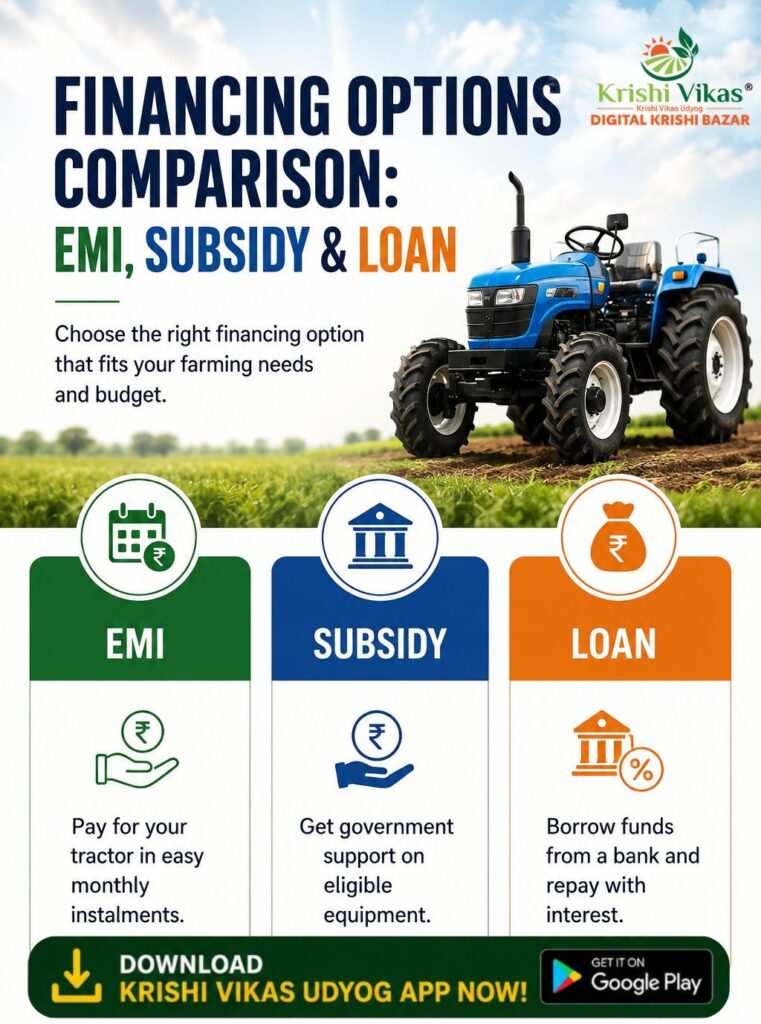
EMI, Subsidy or Loan
| Option | What it means | Main benefit |
| Tractor Loan | Money borrowed from a bank or financial institution to purchase a tractor | Spreads the purchase cost over several years |
| EMI | A fixed periodic payment used to repay a loan | Makes repayment easier to budget |
| Subsidy | Financial assistance provided under eligible government schemes | Reduces the effective purchase cost |
1. Tractor Loan
A tractor loan allows a farmer to purchase a tractor by borrowing money from a bank or other eligible financial institution instead of paying the entire cost from personal savings. The farmer generally contributes a portion of the purchase price as a down payment, while the lender finances the remaining eligible amount. The farmer then repays the loan over an agreed period along with applicable interest and charges.
For example, suppose a farmer wants to purchase a tractor priced at ₹8 lakh. If the farmer can contribute ₹2 lakh from savings and obtains financing for the remaining ₹6 lakh, the ₹6 lakh becomes the principal amount of the tractor loan. The farmer then repays this amount according to the lender’s repayment schedule. The actual down payment, loan amount, interest rate and tenure will depend on the lender’s terms and the farmer’s eligibility.
A tractor loan can be particularly useful when a farmer needs a tractor immediately but does not want to use all of their savings. Keeping some money available for seeds, fertilisers, labour, fuel, irrigation and other farm expenses can be important because agricultural income is often seasonal.
How It Works
The basic process generally involves:
- Selecting a suitable tractor.
- Comparing loan offers from eligible lenders.
- Submitting the required documents.
- Completing the lender’s eligibility and verification process.
- Making the required margin or down payment.
- Receiving loan approval and disbursement.
- Repaying the loan through scheduled instalments.
Advantages
- Reduces the need for a large upfront payment.
- Allows repayment over a longer period.
- Helps farmers purchase tractors that may otherwise be difficult to afford.
- Can support investment in farm mechanisation.
Before taking a tractor loan, compare the interest rate, processing charges, down payment, repayment tenure, prepayment conditions, and total repayment amount. A lower EMI does not always mean a cheaper loan. A longer tenure can reduce the monthly payment but increase the total interest paid.
2. EMI-Based Tractor Financing
EMI stands for Equated Monthly Instalment. It is the regular payment made by the borrower towards the loan. The EMI generally includes both the principal and interest components.
For example, if a farmer takes a tractor loan of ₹6 lakh, the lender may allow repayment over several years. Instead of asking the farmer to repay ₹6 lakh immediately, the amount is divided into scheduled instalments, with interest calculated according to the loan agreement. The farmer therefore makes regular payments until the loan is fully repaid.
The exact EMI depends on factors such as the loan amount, interest rate and repayment tenure. For illustration, if two farmers borrow the same amount but choose different repayment periods, the farmer choosing the longer tenure may have a lower EMI, while potentially paying more total interest over the entire loan period. This is why farmers should not choose a loan simply because it has the lowest EMI. A lower EMI can sometimes mean a longer repayment period and a higher overall financing cost.
An EMI generally consists of two components:
- Principal: The amount borrowed.
- Interest: The lender’s charge for providing the loan.
For example, if a farmer purchases a tractor using financing, instead of paying the entire amount immediately, the financed amount can be repaid through scheduled EMIs according to the loan agreement. The EMI should match the farmer’s expected cash flow. Agricultural income can be seasonal, so farmers should consider whether the repayment schedule fits their crop cycles and other farm expenses.
Lower EMI vs Lower Total Cost
Suppose two loans finance the same tractor:
- Shorter tenure: Higher EMI but potentially lower total interest.
- Longer tenure: Lower EMI but potentially higher total interest.
Therefore, farmers should compare both monthly affordability and overall loan cost before choosing a financing plan.
3. Government Tractor Subsidy
A subsidy is different from a loan. Under eligible government agricultural mechanisation schemes, farmers may receive financial assistance for approved agricultural machinery, subject to the applicable scheme’s rules.
The amount of assistance, eligible beneficiaries, approved machinery, maximum limits and application procedure can vary depending on the scheme and state. Therefore, farmers should always check the latest official guidelines before assuming that a particular tractor purchase will receive a subsidy.
For example, suppose a farmer purchases eligible agricultural machinery costing ₹8 lakh and qualifies for a hypothetical subsidy of ₹1.5 lakh, subject to the scheme’s rules. The farmer’s effective financial burden could potentially be reduced by that amount. The remaining amount may be arranged through personal savings, financing or another permitted source. Actual subsidy percentages and maximum amounts vary by government scheme, farmer category, machinery and state.
How Subsidy Helps
If a farmer qualifies for a subsidy, it can reduce the effective financial burden of purchasing eligible agricultural machinery.
For example:
Tractor/Machinery Cost → Eligible Subsidy → Remaining Amount to be Arranged
The remaining amount may potentially be paid using savings, a loan, or other permitted financing arrangements, depending on the applicable scheme.
Farmers should not assume that every tractor purchase automatically qualifies for a subsidy. Eligibility and approved equipment requirements must be checked before relying on subsidy support.
Tractor Financing Options – EMI vs Subsidy vs Loan Comparison
| Factor | EMI | Loan | Subsidy |
| Purpose | Repayment method | Financing method | Financial assistance |
| Repayment required? | Yes | Yes | Generally no repayment of the assistance itself, subject to scheme conditions |
| Interest | Depends on the underlying loan | Usually applicable | No loan interest on the subsidy amount |
| Reduces purchase cost? | No | No | Potentially |
| Eligibility | Based on financing agreement | Based on lender criteria | Based on government scheme rules |
| Best suited for | Managing periodic payments | Funding tractor purchase | Reducing eligible purchase cost |
Which Option Is Better for Farmers?
Choose Loan + EMI When:
- You need financing to purchase the tractor.
- You have sufficient and predictable repayment capacity.
- You want to spread the cost over multiple instalments.
Consider Subsidy When:
- You meet the eligibility requirements of an applicable government scheme.
- The tractor or machinery qualifies under the scheme.
- The application and documentation requirements can be fulfilled.
Consider Combining Options
In some situations, eligible subsidy support and financing can work together. For example, a farmer may qualify for financial assistance and arrange the remaining eligible amount through a loan. However, the exact structure depends on the applicable subsidy scheme and lender’s terms.
5 Things to Check Before Financing a Tractor
1. Calculate Your Down Payment – A larger down payment can reduce the amount you need to borrow and may lower the EMI.
2. Compare Interest Rates – Don’t compare only the EMI. Check the interest rate and total repayment amount.
3. Choose a Practical Tenure – Select a repayment period that balances affordable EMIs with the total cost of borrowing.
4. Check Subsidy Eligibility – Before finalising the purchase, check whether any applicable government scheme can provide assistance for the tractor or machinery you intend to purchase.
5. Match Repayments With Farm Income – Consider crop cycles, seasonal income, existing loans, fuel expenses, maintenance costs, and other agricultural expenses before committing to an EMI.
How Krishi Vikas Helps Farmers Make the Right Choice
Krishi Vikas helps farmers explore tractors and agricultural machinery while connecting them with dealers, making it easier to compare options based on actual farming requirements—not just price or EMI.
Choosing the right financing option is only one part of buying a tractor. Farmers should also consider land size, crops, required horsepower, implements, usage and budget before making a decision.
For example, a farmer cultivating 10 acres may have different tractor requirements from one managing 50 acres. Similarly, crops such as rice, wheat, sugarcane and cotton may require different tractor capabilities and implement combinations.
A higher-horsepower tractor with an attractive EMI may not always be economical if it exceeds the farmer’s actual requirements. On the other hand, choosing the cheapest tractor may not provide the best value if it cannot efficiently handle the required farming operations.
Krishi Vikas helps farmers explore tractor options based on horsepower, acreage, crop requirements, implements and budget, and then connect with dealers to understand available models, prices and financing options.
The goal is simple: help farmers make informed tractor-buying decisions by comparing suitability, specifications, cost, financing and dealer options before making the final purchase.
Final Takeaway
Tractor Financing Options – Loan, EMI, and subsidy are not competing concepts, they can play different roles in tractor financing. A loan provides the funds, EMI determines how the borrowed amount is repaid, and an eligible subsidy can potentially reduce the financial burden of purchasing approved agricultural machinery. For farmers, the best approach is to compare the total cost, interest rate, EMI, down payment, repayment tenure, and subsidy eligibility before making a decision.
At Krishi Vikas, farmers can explore tractors and agricultural machinery from dealers and make more informed purchasing decisions based on their farming requirements, acreage, crop, and budget.
Frequently Asked Questions
1. Is EMI the same as a tractor loan?
No. A loan is the money borrowed to purchase the tractor, while EMI is the periodic payment used to repay that loan.
2. Does a tractor subsidy have to be repaid?
A genuine subsidy is generally financial assistance rather than a conventional loan. However, beneficiaries must follow the applicable scheme’s conditions. Always verify the current official rules.
3. Can I get a tractor loan without a subsidy?
Yes. Tractor financing and government subsidy are separate concepts. A farmer may be able to obtain financing even when they are not eligible for a particular subsidy scheme, subject to lender approval.
4. Can a subsidy and loan be used together?
In some cases, eligible subsidy assistance and loan financing may be combined. The exact arrangement depends on the applicable government scheme and lender.
5. Is a lower EMI always better?
No. A lower EMI may result from a longer repayment tenure, potentially increasing the total interest paid.
6. Should I make a large down payment?
A larger down payment can reduce borrowing and interest costs, but farmers should avoid exhausting their working capital.
7. What should I compare between two tractor loans?
Compare the interest rate, loan amount, tenure, EMI, processing fees, insurance requirements, prepayment terms, late charges, and total repayment amount.
8. How can I find out whether my tractor qualifies for a subsidy?
Check the latest eligibility criteria and approved machinery under the relevant central or state government scheme. Do not rely solely on dealer claims or older information.