Tractor Insurance Claim Guide: Timeline & Documentation Needed for Farmers and Tractor Owners
Insurance can protect a farmer from a major financial loss when a tractor or other agricultural vehicle is damaged, stolen, or involved in an accident. But knowing that insurance exists is only one part of the process. Timely claim intimation, proper documentation, survey and settlement procedures all affect how smoothly a claim is processed. For tractor owners, understanding the current insurance claim process is particularly important because a tractor can be a significant investment and may be essential to farm operations. This tractor insurance claim guide explains the insurance claim timeline, documents required, surveyor process, common reasons for delays and important IRDAI provisions applicable to retail general insurance claims in India. Also read the State-Wise Tractor Subsidy 2026 blog at Krishi Vikas.com.
What Is an Insurance Claim?
An insurance claim is a formal request made by a policyholder to an insurer for compensation for a loss covered under the insurance policy.
For a tractor, a claim may arise because of events such as:
- Road accidents or collisions
- Fire
- Theft
- Flood or water-related damage
- Storm, cyclone or other natural calamities
- Malicious damage, where covered
- Other insured risks specified in the policy
Whether a claim is payable depends on the policy coverage, exclusions, deductibles, insured value and circumstances of the loss.
Insurance Claim Timeline: Step-by-Step
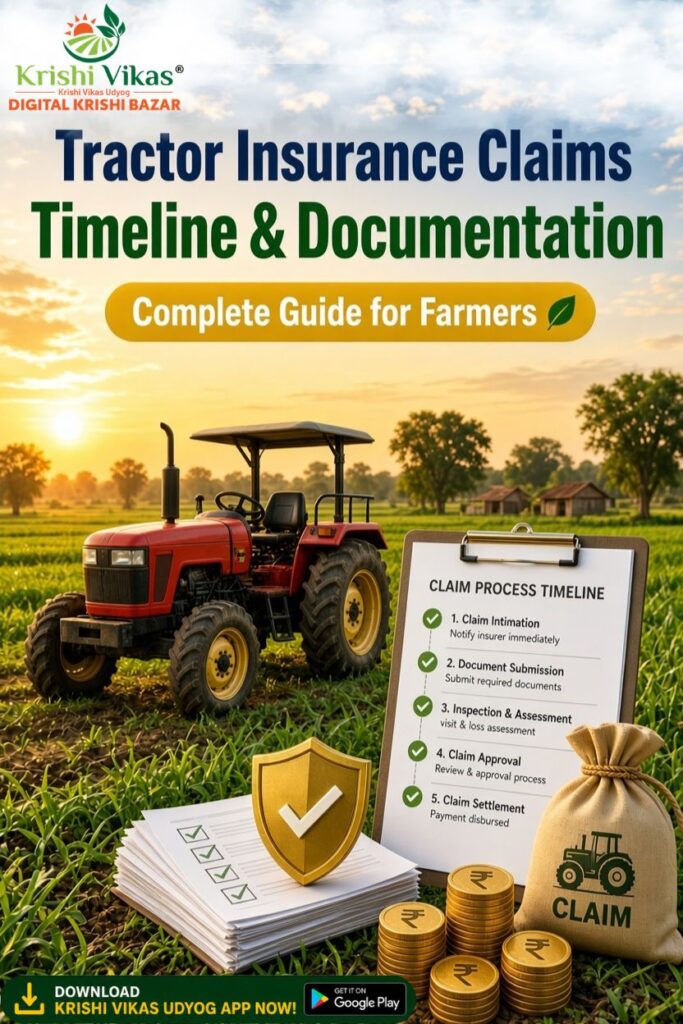
The claim process generally moves through several stages. IRDAI’s 2024 framework introduced specific timelines for retail general insurance claims involving surveyors.
1. Inform the Insurer as Soon as Possible
The first step after an insured incident is to notify the insurer.
IRDAI’s policyholder guidance says an insured should give notice of a loss at the earliest or within any extended period allowed by the insurer.
For tractor owners, it is advisable to report the incident immediately rather than waiting until the extent of damage becomes clear.
When reporting the claim, keep the following information ready:
- Policy number
- Tractor registration number
- Date and time of incident
- Location
- Nature of loss or damage
- Contact details
- Brief description of what happened
The insurer will generally provide a claim reference number. Keep this number for future communication.
2. Surveyor Allocation
Retail general insurance claims where a surveyor is required, the IRDAI Master Circular on Protection of Policyholders’ Interests, 2024 provides that the surveyor should be allocated within 24 hours of reporting the claim. For motor insurance, the circular specifies mandatory survey by a registered surveyor and loss assessor for reported losses of ₹50,000 or more. For other general insurance products, the corresponding threshold is ₹1 lakh. Once a surveyor is allocated, the insurer should communicate the surveyor’s details and responsibilities to the policyholder.
Why Is the Survey Important?
The surveyor assesses the loss and provides the insurer with a report that can help determine the admissible claim amount.
For a damaged tractor, the assessment may consider:
- Extent of physical damage
- Damaged components
- Repair or replacement requirements
- Estimated repair cost
- Applicable depreciation
- Policy excess/deductible
- Whether the damage falls within policy coverage
3. Surveyor’s Report: 15-Day Timeline
Under the 2024 Master Circular, the surveyor is required to submit the survey report to the insurer within 15 days of allocation. The insurer has a responsibility to obtain the report within the prescribed timeline. The framework also provides for a ₹500-per-day payment to the claimant for delay by the surveyor beyond the stipulated 15 days, subject to the applicable provisions. This is important because the survey stage can otherwise become a major source of delay in vehicle and property claims.
4. Insurer’s Claim Decision
Once the survey process is completed, the insurer evaluates the claim. Under the 2024 Master Circular for retail general insurance, the insurer is required to decide the claim within seven days of receiving the survey report or after expiry of 15 days from surveyor allocation, whichever is earlier, subject to the stated exceptions.
The decision may result in:
- Approval of the claim
- Approval for a particular amount
- Request for clarification or additional information
- Partial settlement
- Rejection/repudiation, with reasons where applicable
This does not mean every tractor claim will necessarily be settled within seven days from the date of accident. The claim must first go through the applicable intimation, documentation and assessment process.
5. Payment After Settlement Acceptance
Once the policyholder accepts an offer of settlement, the payment process follows the applicable policy and regulatory requirements. The IRDAI framework provides that, upon acceptance of the settlement offer, the amount due should be paid within seven days from the date of acceptance. Where payment is delayed beyond the applicable stipulated period, the regulatory framework provides for interest at 2% above the bank rate, subject to the applicable provisions.
Insurance Claim Timeline
| Stage | Indicative IRDAI Timeline |
| Claim intimation | At the earliest / as permitted by policy |
| Surveyor allocation, where required | Within 24 hours of claim reporting |
| Survey report | Within 15 days of allocation |
| Insurer’s claim decision | Within 7 days of survey report or expiry of 15 days from allocation, whichever is earlier, subject to applicable provisions |
| Payment after settlement acceptance | Within 7 days |
| Surveyor delay beyond stipulated period | ₹500 per day, as provided under the applicable framework |
Documents Required for a Tractor Insurance Claim
IRDAI’s motor insurance guidance lists documents generally required for a motor insurance claim, including a duly completed claim form, RC copy, original loss estimate, original repair invoice and payment receipt. For cashless claims, the documentation may differ; theft claims can require the vehicle keys and a non-traceable certificate.
| Document | Purpose |
| Insurance policy/certificate | Confirms insurance coverage |
| Claim form | Records details of the claim |
| Registration Certificate (RC) | Establishes vehicle registration and ownership |
| Driving licence | Establishes driver’s licence status |
| Repair estimate | Shows expected repair cost |
| Repair invoice | Supports actual repair expenditure |
| Payment receipt | Evidence of payment for repairs |
| Photographs/videos | Evidence of damage and incident |
| FIR/police report | Required for certain accidents, theft and other cases |
| Tractor keys | May be required for theft claims |
| Non-traceable certificate | Generally relevant to theft claims after police investigation |
| Bank details | May be required for settlement |
| Other policy-specific documents | Depends on insurer and claim |
Documents for Different Types of Tractor Claims
1. Accident or Collision Claim
For an accident-related claim, the insurer may require:
- Claim form
- Insurance policy details
- Tractor RC
- Driving licence
- Repair estimate
- Photographs of the tractor
- Accident details
- FIR/police report where applicable
- Repair invoice and payment receipt
2. Theft Claim
Theft claims usually involve more documentation because the insurer needs evidence that the vehicle was stolen and has not been recovered. IRDAI specifically notes keys and a non-traceable certificate in its motor insurance guidance for theft claims.
Commonly required documents may include:
- Claim form
- Insurance policy
- RC
- FIR
- Original keys
- Non-traceable certificate
- Other documents requested by the insurer or police
3. Fire or Natural Calamity Claim
For damage caused by fire, flood, storm or another insured event, the policyholder may need:
- Claim form
- Policy details
- RC
- Photographs/videos
- Repair estimate
- Surveyor assessment
- Fire brigade or police report, where applicable
- Repair bills and receipts
Can an Insurer Reject a Claim Because of Missing Documents?
IRDAI’s 2024 framework states that a general insurer should not reject a claim for want of documents where the documents are not necessary for claim settlement. The insurer is expected to collect necessary documents at the appropriate stage, and the customer should generally be asked for documents directly related to settlement. This is an important change for policyholders. This does not mean that documentation is unnecessary. Policyholders still need to provide documents and information that are genuinely required to establish and process the claim. For example, a theft claim may require police documentation, while a repair claim may require an estimate and repair invoice.
Can a Delay in Reporting Automatically Cancel a Claim?
Policyholders should always report losses promptly because the policy may prescribe a notification requirement. However, the 2024 framework also provides protection in certain circumstances.
For example, a claim cannot be repudiated in full or part merely because of a delay by the policyholder where that delay has not resulted in an increase in the assessed loss, subject to the applicable provisions. This does not mean farmers should delay reporting. Immediate notification remains the safest approach.
What Should a Farmer Do After a Tractor Accident?
Step 1: Ensure Safety
Move people away from traffic, fire, electrical hazards or other dangers.
Step 2: Inform the Authorities if Required
For serious accidents, theft or other incidents requiring police involvement, file the appropriate report.
Step 3: Notify the Insurer
Provide the policy and incident details and obtain the claim reference number.
Step 4: Document the Damage
Take photographs and videos of:
- Front and rear of tractor
- Damaged components
- Engine area
- Wheels and tyres
- Hydraulic system
- Implements, if relevant and covered
- Accident location
- Other vehicles involved
Step 5: Wait for the Required Inspection
Do not undertake major repairs before the insurer’s inspection where the policy/insurer requires assessment first.
Step 6: Submit Required Documents
Provide the documents requested for claim settlement.
Step 7: Keep Every Record
Save:
- Claim number
- Surveyor details
- Repair estimate
- Emails/messages
- Survey documents
- Repair invoice
- Payment receipts
- Settlement communication
Cashless vs Reimbursement Claims
Farmers may encounter two broad repair-claim processes.
Cashless Claim
Under a cashless arrangement, the insurer settles the admissible repair amount directly with a network workshop, subject to policy terms. IRDAI notes that in cashless motor claims, the documentation requirement can differ from reimbursement claims.
The policyholder may still have to pay:
- Deductible/excess
- Non-covered parts or services
- Depreciation, where applicable
- Other amounts not payable under the policy
Reimbursement Claim
In a reimbursement claim, the policyholder pays the repair bill and subsequently submits the required documents to the insurer for reimbursement of the admissible amount. The policyholder should retain the original repair invoice and payment receipt where required.
What Determines the Final Claim Amount?
1. Sum Insured / Insured Declared Value
The maximum liability and applicable valuation method depend on the policy.
2. Deductible
The policyholder may have to bear a specified deductible.
3. Depreciation
Depending on the policy and coverage, depreciation may affect the amount payable for certain parts.
4. Policy Exclusions
Damage arising from excluded circumstances is generally not payable.
5. Nature of Damage
The surveyor’s assessment and policy terms determine the admissible loss.
6. Add-On Covers
Additional coverage can alter the amount payable for specific risks or expenses.
Therefore, farmers should not assume that the insurer will automatically pay the entire repair bill.
Common Reasons for Insurance Claim Delays
Even with defined regulatory timelines, claims can become complicated when:
- Claim information is incomplete
- Required documents not submitted
- Police verification is pending
- The incident requires investigation
- Damage is extensive
- The surveyor needs additional information
- The policyholder does not cooperate with the survey process
- There is a dispute over coverage
- The loss involves exclusions or policy conditions
- Repair work started before the required inspection
Keeping documentation ready and responding quickly to legitimate information requests can help reduce avoidable delays.
What If the Insurance Claim Is Rejected?
If a claim is rejected, the policyholder should not rely only on a verbal explanation.
Ask the insurer for:
- Written claim decision
- Specific reason for rejection
- Relevant policy clause
- Survey report, where applicable
- Details of the insurer’s grievance redressal mechanism
The policyholder can then review the decision and raise a grievance through the insurer’s designated grievance process if necessary. IRDAI’s 2024 policyholder-protection framework places emphasis on effective grievance redressal and improving the claims experience.
Tractor Insurance Claim Checklist
- Check that the tractor insurance policy is active.
- Report the incident to the insurer promptly.
- Note the claim reference number.
- File an FIR/police report where applicable.
- Photograph and record the damage.
- Keep the RC available.
- Keep the relevant driving licence available.
- Obtain a repair estimate.
- Cooperate with the surveyor.
- Keep repair invoices and payment receipts.
- Submit only the documents relevant to claim settlement.
- Keep copies of all documents submitted.
- Track the claim using the reference number.
How Krishi Vikas Help Farmers
Understanding the insurance claim process is important, but farmers may also need support when buying, comparing and maintaining tractors. Krishi Vikas can help simplify the tractor-buying journey by providing information on tractor models, specifications, prices, financing options and dealers.
Farmers can use Krishi Vikas to:
- Explore tractor models based on horsepower, features and farming applications.
- Compare tractor options according to land size, crops, implements and budget.
- Find and connect with tractor dealers for pricing, availability and purchase-related information.
- Understand financing options such as tractor loans and EMI plans.
- Research agricultural machinery and implements that can complement tractor usage.
- Make informed purchase decisions instead of selecting a tractor only on price or EMI.
When purchasing a tractor, farmers should also discuss insurance requirements with the insurer or authorised dealer. Before taking a policy, they should check the coverage, exclusions, deductibles, insured value, claim procedure and documents required.
Krishi Vikas primarily helps farmers discover and compare tractors and agricultural machinery and connect with dealers. Insurance coverage, claim approval and settlement are determined by the respective insurance company according to the applicable policy terms and regulations.
Final Takeaway
For farmers, an insurance claim should be treated as a time-sensitive documentation and verification process, not simply a request for reimbursement. The key steps are straightforward: report the loss promptly, preserve evidence, cooperate with the surveyor, submit relevant documents and track the claim using the reference number.
Under the IRDAI framework introduced in 2024, applicable retail general insurance claims have defined timelines for surveyor allocation, survey reports, claim decisions and settlement payments.
For tractor owners, understanding these timelines before an accident or loss occurs can make the claims process more predictable and help avoid unnecessary delays.
Source note: This article is based primarily on IRDAI’s 2024 Master Circular on Protection of Policyholders’ Interests and IRDAI’s motor-insurance guidance. Individual policy terms and claim circumstances can differ.
Disclaimer: This article is for informational purposes only. The exact requirements can vary according to the insurance policy, insurer and type of claim. Policyholders should always check their policy wording and the insurer’s instructions. Insurance coverage, claim timelines and documentation requirements may vary by insurer and policy. Always check your policy terms and confirm the latest requirements with your insurer. Krishi Vikas does not guarantee insurance claim approval or settlement.
Frequently Asked Questions
1. How quickly should I report a tractor insurance claim?
The safest approach is to notify the insurer as soon as the incident occurs. The applicable policy may specify a notification period. IRDAI’s policyholder guidance says loss should be reported at the earliest or within any extended time allowed by the insurer.
2. How quickly should a surveyor be appointed?
For applicable retail general insurance claims, the 2024 Master Circular provides for surveyor allocation within 24 hours of claim reporting.
3. How long does a surveyor have to submit the report?
The surveyor is required to submit the report within 15 days of allocation under the applicable 2024 framework.
4. How long does payment take after accepting the settlement?
The 2024 framework provides that payment should be made within seven days after acceptance of the settlement offer, subject to applicable provisions.
6. Is an FIR required for every tractor claim?
No. An FIR is not required for every claim. It is particularly relevant to claims involving theft and certain accidents or incidents. The insurer’s specific requirements should be followed.
7. Can I repair my tractor before the survey?
Major repairs should generally wait until the required inspection or approval has been completed. If immediate repairs are necessary for safety or to prevent further damage, document the situation carefully and inform the insurer.
8. What is the most important document for a tractor insurance claim?
There is no single document that works for every claim. The policy, claim form, RC, repair estimate/invoice and evidence of the loss are commonly important, while theft and other incidents may require additional documentation.